The post Small Steps, Big Impact: Sense Employees Share Their Green Resolutions appeared first on Sense.
]]>Big Changes at Home
Several employees are tackling large-scale home upgrades to cut energy use and shrink their carbon footprint:
- Installing heat pumps: Jono and Deanne are replacing their HVAC systems with heat pumps this spring. These systems not only lower energy bills and reduce greenhouse gas emissions but also offer consistent temperature and humidity control. Bonus: They often qualify for rebates!
- Boosting insulation: Karen recently improved insulation throughout her home and expects to save up to 20% on heating and cooling costs. She’s using her Sense system to track the difference compared to last year. Stay tuned—we’ll share her results soon!
Everyday Changes That Add Up
Not every resolution involves a major project. Many of us are focusing on smaller, everyday actions, like grocery shopping habits:
- Buying local foods: Reducing the distance food travels helps cut greenhouse gas emissions. Deanne is skipping red meat entirely, while Jono recommends choosing locally sourced meats. For shrimp lovers, Karen is cutting back while Heather suggests opting for sustainable wild Pacific blue shrimp.
- Reducing plastic waste: We’re paying closer attention to packaging. PETE (#1) and HDPE (#2) plastics are the easiest to recycle, so we’re choosing those over less-recyclable plastics (#3–7) to ensure our recycling efforts make a real impact.
Inspiration for Your Resolutions
Whether it’s a major home improvement or a simple lifestyle tweak, every choice helps build a greener future. What steps will you take this year?
Learn more about reducing your energy use with Sense insights. Discover how Sense can help →
The post Small Steps, Big Impact: Sense Employees Share Their Green Resolutions appeared first on Sense.
]]>The post Are you ready for this year’s heat waves? appeared first on Sense.
]]>Trends also show there are more heat waves, they last longer, and they bring more extreme day – and night – temperatures. The news is filled with stories about health effects, especially for vulnerable populations, including the very old and the very young. All this comes from climate change, and it is something we can address head on.
In the summer, electrical usage in much of the U.S. and Canada peaks from the use of air conditioning, a primary tool for keeping ourselves comfortable. We need to keep our families safe. But heat waves also lead, increasingly often, to power outages as high demand challenges the grid. We need to conserve energy even as we rely on it to keep us safe. So, air conditioning can’t be the only tactic to employ against extreme heat.
What are heat waves?
Heat waves are weather events where unusually high temperatures are recorded for consecutive days–but also nights, when a body should cool off to recover from the heat of the day.
In the U.S., the EPA starts with the temperature of the nine hottest days in July and August, the two hottest months. They factor in humidity, then define a heatwave as two or more consecutive days that exceed the 85th percentile of those high temperatures. Humidity must be included in these calculations, as humidity makes us feel hotter and makes it more difficult for our bodies to cool by sweating. This “apparent temperature” where you live is often discussed as the heat index or the “feels like” temperature.
Heat waves are of particular concern in urban areas due to the oven-like effect of urban infrastructure like roads, pavements and buildings that close off land and retain heat. In the past 50-60 years, the frequency and duration of heat waves has increased in urban areas across the United States and Canada, endangering health and resulting in spikes in energy use that challenge the grids and increasingly cause brown-outs or even power failures.
By 1961 in the U.S., most cities had started measuring temperatures consistently (often at airports), so that year is often used as a baseline to look at increases. According to NOAA, heat waves averaged just over two per season in 1961, and that number has increased to six since the 2010s (46 out of 50 cities). Average heat waves lasted three days, but in recent years they’ve endured for four days (and more) in 28 out of 50 cities. The average heat wave season is now 46 days longer than in the 1960s. They occur earlier in the year and endure later in 46 out of 50 cities, and these periods of unusual heat in late spring or early fall are more likely to catch people off guard, leading to more health risks. Finally, heat waves have become even more intense: In the 1960s, the temperatures of heat waves were 2°F above the local threshold, and now in 20 cities the average temperatures are 2.5°F above even as average thresholds are also rising.
How to save energy during a heat wave?
We need to preserve our own health and energy. All choices must keep this in mind, but there are a lot of options. Following are some reminders to help us all reconsider – and amend – daily habits for summer, generally, and heat waves in particular.
Staying healthy during extreme heat
Even small increases in extreme heat can contribute to increased heat-related illnesses and deaths, so extreme events are good times to rethink some of our habits to ensure we avoid ill effects.
Try to avoid going outside, especially for exercise or labor during the hottest hours of 3pm to 7pm. If you do go out, make sure you wear a hat or other head covering and keep a hydration kit handy that includes bottled water and electrolyte drinks, hand towels, a hand fan.
Use water to stay hydrated and also to cool your body. Avoid hot foods and focus on foods that help hydrate, such as raw fruits and vegetables.
Some of the biggest effects of a heat wave come from high night time temperatures, so your energy choices for night should make sure that your home allows you to cool off. Instead of cranking up the air conditioning, consider cool or lukewarm showers before bed and increased use of fans. Fans, especially ceiling fans, may not cool a room but they can make a person feel cooler as they circulate air around the body.
For Heat Wave Safety Information from the American Red Cross, check out this Red Cross Safety Checklist.
Saving energy throughout your home
We are all interested in conserving energy and saving money, but of course this becomes more difficult during an extreme weather event. Here are some ways you can save. You can rely on your Sense Home app to keep track of your energy and look for inefficiencies. And the Compare reports also let you see how well your home is doing against similar homes.
Start by keeping your home cool in ways that don’t rely solely on air conditioning. Keep sun, heat and humidity out of your home by closing curtains and blinds, and keeping windows closed when it’s hot. Did you know that brightly colored curtains and blinds reflect heat most effectively? This avoids the AC working harder to keep the space cool. Keeping AC filters clear is another way to reduce AC workload. Most filters are ready for cleaning every month or so. Turn up the AC temp and open windows when temperatures are cooler, during morning and later evening hours, and use fans to bring in that cooler air – or to expel hot air later in the day.
Cook wisely to reduce energy usage. Try reducing the use of the oven and stove top to help keep the kitchen cool. This may mean cooking outdoors, using smaller appliances (toaster oven), or planning more uncooked dishes. The Meter and Devices reports in your Sense Home app will confirm the differences here. Keep refrigerator temps to 36F to 38F degrees and the freezer at 15 degrees. You can even organize the items in your refrigerator to put things used most often nearer to the front, and reduce the time the door is open.
Reduce the temperature on your hot water heater, and overall avoid using hot water as much as possible. Heating water can account for up to 30% of a home’s energy use. Wash clothes only in cold water, during morning or late evening hours, and try to wash only full loads. And remember that cool or lukewarm showers can help keep you cooler.
Turn off lights (especially if they aren’t LED), computers, televisions, printers, monitors and other appliances when they are not in use. You may also want to simply unplug appliances you’re not using. Many of these will be included in your Other and Always On bubbles in the Sense Home app, so this is a good way to reduce the size of those bubbles. You can turn off the drying feature in your dishwasher and let dishes dry by themselves, and limit your use of the dishwasher and clothes dryer.
Did you know that your TV might be using more energy than necessary? The “Quick Start” may save a few seconds at startup, but it is always consuming power. You might also adjust the picture brightness to better match the light in the room, especially if you watch mostly in the evenings. And to stream movies, avoid using a game console, which uses up to 30x more energy; instead, use an internet-ready TV or an add-on device like Roku that uses very little power.
Reductions like these are especially important between 5pm and 9pm each day, when electricity demand is highest overall. And as always, you can adjust your thermostats as much as health and comfort permit. For each degree you lower your thermostat, you can use 3% less energy.
Resources
EPA on Heat Waves and more from the EPA
The post Are you ready for this year’s heat waves? appeared first on Sense.
]]>The post Empowering a Cleaner Future: Sense’s Mission to Combat Climate Change appeared first on Sense.
]]>Though it’s easy to feel overwhelmed in the face of climate change, we do have the power to tackle these challenges. We are in the midst of a massive technological revolution that presents solutions and opportunities that allow each of us, individually, to make a difference. Sense is one such solution.
Our goal is simple: to reduce global carbon emissions by transforming the relationship between people, homes, and the grid. Founded with the purpose of applying our expertise in voice recognition to make an impact on climate change, Sense gives homeowners agency over their own energy use. You might say we give you power over your power.
Why building energy efficiency matters
Today, 70% of greenhouse gas emissions stem from energy use, with homes contributing to a quarter of these emissions. Clearly, our homes—and how they’re powered—make a difference.
While the energy industry is attempting to adapt, it’s facing an uphill battle, with aging infrastructure, growing pressures from technologies like electric vehicles and heat pumps, and permitting issues—among many other challenges. Renewable energy is making inroads, with 21% of U.S. energy production, but it still has a long way to go.
In order to reduce emissions, it’s crucial that we use energy as efficiently as possible. Sense gives homeowners the ability to do that—and tens of thousands already are. In the next few years, this same technology will be available to millions more people at no cost.
Sense’s blueprint for change
In the past, none of us had much insight into our home energy use. We might get a monthly bill and imagine that we owe more than usual because we were running the heat or AC on high all month, but there wasn’t an easy way to know the cause. The technology just wasn’t there.
Now, Sense turns data into clear insights that people can use when making everyday decisions. For example, we help homeowners decide when to run their appliances or make home energy upgrades. And, in partnership with electric utilities, Sense is making the grid more intelligent and reliable.
Sense helps homeowners do the following:
- Gain insights into their energy use: Knowledge is power, and our data-driven intel helps people cut down on energy use. Our app helps homeowners see how much energy their home is consuming in real-time and how it compares to previous months.
- Detect energy hogs: Sense alerts people to energy-guzzling devices that would otherwise slip under the radar. For example, It can identify appliances that run all the time unnecessarily or sometimes identify equipment that is nearing the end of its life. With that information, the Sense Home app helps people understand all the different ways they could troubleshoot and stop the hogs.
- Make smart consumer decisions: We help homeowners understand the real-world cost savings of energy-efficient upgrades, which in turn helps them decide which upgrades to make and when.
- Make the most use of solar: Solar is a key part of the energy transition, but homeowners don’t always understand how to use it to its full potential. Sense makes it easy to use more of the power your solar system produces by providing a real-time view of how much you’re producing, using, and selling back to the grid.
- Shift energy use: Running devices at less popular times can ease strain on the grid, reduce emissions, and, depending on your utility plan, save you money. Sense helps people do all of this with ease.
- Reduce their carbon footprint: Utilities use different fuel sources at different times, all of which produce different amounts of “carbon intensity,” which is the amount of carbon dioxide emitted to generate a specific unit of power. The higher the intensity, the greater the environmental impact. Where possible, we give homeowners info about how much carbon intensity they’re using, allowing them to make informed decisions about when to use energy.
What’s next?
We envision a world in which homeowners have even easier, more sophisticated ways to align their energy use with their goals. Many of these changes will serve the double function of saving homeowner’s money and reducing emissions.
We hope to give users more real-time insights that enable them to take advantage of clean, cheap energy in many different circumstances—for instance, by helping them get the most from time-of-use rate plans. Our goal is to make it as easy as possible to optimize a home’s energy use.
We’re also exploring solutions like automated energy use, which could make it effortless to charge electric vehicles at the optimal time of day, while maintaining a minimum specified charge. And we’re moving towards more personalization in the app so that we can recommend home appliance upgrades that maximize utility bill savings.
While homeowners are at the center of our work, we believe addressing climate change will take a village. We’re looking at the big picture, working with the entire energy industry to have the greatest impact possible.
At Sense, we don’t just believe in a better future; we’re actively creating it. Last year alone, our work saved roughly 22,000 tons of CO2. This is just the beginning. Join us in reimagining power.
The post Empowering a Cleaner Future: Sense’s Mission to Combat Climate Change appeared first on Sense.
]]>The post How Are We Going to Handle Electrifying Everything? appeared first on Sense.
]]>This transition will come with many benefits. Electric vehicles and appliances reduce pollution and our reliance on fossil fuels. Induction stoves are more energy efficient and reduce indoor air pollution. Heat pumps keep our homes comfortable while saving on energy bills. And importantly, when all of these things are powered by electricity instead of other energy sources, they can run on renewable energy.
People opposed to large-scale electrification say that the grid can’t handle such a large increase in demand. While it will be difficult to electrify everything, we can absolutely do it over the next few decades. Yes, there will be challenges – like infrastructure upgrades and supply chain issues – but there are smart ways to tackle them and get us where we need to be.
For example, a key component will be giving both utilities and consumers real-time information about what supply is available and how it could best be utilized to benefit not only a single home, but the whole grid.
Electrifying everything can work. In this article, we’ll explore how.
How the grid operates and reacts to increases in demand
Electric utilities have the difficult job of constantly matching energy supply and demand. When that balance is achieved, all of our lights, appliances, and electronics work without a hitch. But when demand increases or supply falters, utilities have to figure out how to maintain reliability without making energy unaffordable.
Here’s how utilities currently respond to increasing demand and the challenges that come with them:
1. New power plants
Connecting new power plants to the grid, whether to increase baseload power or to supplement peaking power, like in a heat wave or snow storm, is an expensive and lengthy process.
Power generators and the utilities that transmit and distribute electricity are decoupled in most areas, which means that two different groups have to work together to bring new power online. That creates additional steps and red tape.
When a new power plant is proposed, it has to undergo surveys and assessments that can take years to complete. According to research from Lawrence Berkeley National Laboratory, it currently takes about four years to connect a new power plant to the grid. In order to electrify everything, we’ll need to speed up that timeline significantly.
2. New cables and transformers to handle capacity
Once power is generated, it must then be sent from a solar or wind farm to a home or factory many miles away. Transmission lines carry electricity from power plants at a high voltage that helps to reduce power loss over great distances. Once it arrives at a substation, transformers step down the voltage so that it can then be distributed for use in homes and businesses.
All of that equipment – transmission lines, transformers, and distribution lines – have to be built out when new power generators are added to the grid. And that infrastructure is expensive.
According to the Niskanen Center, the average cost of transformers has risen by a factor of two to three since 2020. It also takes longer for utilities to receive new equipment than it used to. If a utility orders a transformer today, they won’t get the critical infrastructure for another one to two years.
3. Next generation smart meters
Another upgrade needed in order to increase capacity is next generation smart meters with data collection, grid controls, and customer programs built in. Having better real time data to predict, respond to, and manage demand allows utilities and consumers to work together, increasing reliability of the grid, but that will require the right type of technical investment.
All of these capital investments have to be approved by regulators who will be critical of large price tags. That’s why utilities are exploring more efficient ways to improve the grid and build out the capacity we’ll need for an electrified future, while keeping energy costs affordable.
Getting smart about managing the increase in capacity
All of these problems may seem daunting, but there is a viable path to electrifying everything; it just requires smarter solutions.
According to most estimates, we need to double or triple electricity capacity in order to reach net-zero emissions by 2050 while finding ways to improve energy efficiency across homes nationwide. The good news is that there are now more government policies in place to help us get there. The Inflation Reduction Act invests billions in domestic clean energy production, electric vehicles, and includes tax credits and rebates for energy efficient upgrades in your home.
So, how do we best tackle this problem now that we have a bit more support?
Renewable energy generation
The EIA reported that this year, more than half of new electric-generating capacity will come from solar. The cost to develop solar projects is cheaper than fossil fuels. Thanks to a 30 percent tax credit for renewable energy facilities in the IRA, solar will continue to be the most attractive option for power generators going forward.
Battery storage capacity has also grown rapidly and will more than double this year. This growth will ensure that solar power generated during the day can be used at night and on cloudy days.
But many clean energy projects are currently being delayed by bureaucratic processes. In fact, there is a backlog of clean energy projects waiting for connection approval that would get us close to where we need to be by 2050. The entire U.S. electric grid, including every fossil fuel plant, currently has 1,250 GW of installed capacity. The backlog of clean power includes roughly 1,300 GW of solar, wind, and energy storage projects.
In order to electrify everything, we’ll need to get these projects from the queue to the grid much faster. We can do it, but it will require changing both how utilities plan for the future and the regulatory model that incentivizes them to make the right choices.
Replacing old equipment
There is no way around making capital improvements to grid infrastructure. The U.S. grid is aging and many of the components, especially transformers, need replacing in order for the grid to remain operational and reliable.
According to a Department of Energy report, the average transformer in America is about 40 years old, which is near the end of the equipment’s operational life, and 70 percent of transformers are older than 25 years.
Doubling or tripling electric capacity in the coming decades will require upgrades to existing infrastructure as well as new equipment, but more effective load management will be crucial as well. When we can optimize energy consumption relative to energy generation or supply through insights provided by next generation smart meters, we can minimize the stress on the infrastructure, which means reducing the amount of replacements that need to be made.
Distributed energy resources
Distributed energy resources (DERs) will also play a major role in the energy transition. DERs are small-scale installations that generate electricity locally where it will be used—for example, rooftop solar panels, battery storage, or a solar micro-grid. DERs not only add capacity, but do so while requiring less transmission infrastructure because they only require distribution lines to get the electricity from the source to the customer. This makes them cheaper to add to the grid and also means there is little to no power loss between the power generator and the user.
With the IRA and the lower costs of solar and electric vehicles, residential customers will be able to contribute to the grid and help balance supply and demand.
In fact, in California where the governor issued an order requiring all new vehicle sales to be zero emission by 2035, the public utilities see EVs as a critical piece of grid stability, not just a source of new demand. PG&E and SCE are both working on systems that will leverage EVs as bi-directional chargers where the batteries can contribute to the grid in times of peak use.
Electrifying everything will require better data and better customer experiences
All of those improvements won’t be enough without smart tools to manage it all. Today, utilities can only detect how the grid is performing between the power plants and the transformers. Any issues that occur between the transformers and the customers’ homes are unknown. Grid-edge intelligence, or data and insights gathered where the energy is consumed, will help utilities to better understand what’s happening at every point, from energy generation all the way to powering a customer’s appliances.
These types of tools will allow utilities to forecast power demand and ensure reliability throughout the day. They will also open the door to customer-focused programs that empower people to take advantage of off-peak pricing and to make more energy efficient decisions throughout their home.
Utilities and customers will have to work together in order for large-scale electrification to work. That’s where Sense comes in.
A utility is only as reliable as its infrastructure network. Grid-edge intelligence like Sense can help utilities to detect issues before problems occur. Sense will be able to identify cables and transformers that are failing so that utilities can provide that information to regulators and get approval for needed investments.
Sense also helps customers by finding ways for them to save energy in their homes. It shows customers how much energy they’re using, when, and on what devices. This lets customers identify energy hogs and opportunities to save money.
The most natural time to upgrade to a more energy efficient appliance, like a heat pump or induction stove, is when the old version needs replacing. Sense is working to detect when there are problems on a customer’s devices indicating it might be time to replace them. It also promotes initiatives for inefficient devices and energy-efficient behaviors.
Most importantly, Sense bridges the data gap between utilities and customers so that the grid and customers both benefit. It can facilitate demand response programs where utilities can reduce the energy load of participating customers’ homes at peak usage hours to alleviate strain on the grid. Many of these programs pay users to enroll as an added incentive.
Sense can also save customers money with time-of-use management. That’s when customers are encouraged to shift energy use to times of the day when energy prices are lower—for example, charging an EV earlier in the day or overnight instead of during peak evening hours when the grid is most taxed and energy prices are highest.
Stay optimistic
Electrifying everything and increasing our electricity capacity to handle the new demand won’t be easy, but it’s doable with the right resources, tools, and technology.
At Sense, we’re proud to be playing a role in the energy transition. But we can’t make this transition work without you. Keep an eye out for Sense in your region as your utility seeks to upgrade the smart meters on homes in your neighborhood and petition your public utility commission to bring Sense to your home.
The post How Are We Going to Handle Electrifying Everything? appeared first on Sense.
]]>The post Energy Efficiency Must Play a Key Role in States’ Climate Change Plans appeared first on Sense.
]]>Learn how Sense helps utilities
It’s a good thing 75% of U.S. adults surveyed by Morning Consult say that reducing individual carbon emissions influences their behavior, their purchasing decisions or both. Making energy efficiency part of daily thought and action can help the planet meet climate change challenges, and it looks like consumers are ready to do their part.
Are regulators and utilities leveraging that willingness? Not yet, and it’s time for energy efficiency to take a more defined role in meeting state and utility goals in emissions-reduction and climate-mitigation efforts.
That is a key take-away from a recent report, Meeting State Climate Goals: Energy Efficiency will be Critical, published by the American Council for an Energy-Efficient Economy (ACEEE), a nonprofit research organization focused on policy development. In the report, ACEEE examined which U.S. states have clean energy standards (CES),and which have pledged to reach 100% clean electricity generation by some specified date. Researchers found that state CES are “not clearly defining the essential role that energy efficiency must play” to achieve the ambitious goals various states have pledged to meet.
Worse, most states – and the U.S. as a whole – are not on track to meet reductions necessary to meet 2015 Paris agreement goals of cutting emissions to keep global warming below 2 degrees Celsius. The most recent Emissions Gap Report released by the United Nations on October 26 maintains that current national pledges leave the world “on track for a global temperature rise of at least 2.7°C this century.” The time has come for fast action and impact. Energy efficiency can deliver it.
It pays to save
According to the ACEEE report, “ambitious energy efficiency policies can get us about halfway to achieving national GHG goals by 2050.” The International Energy Agency (IEA) agrees. Its recently released roadmap of actions for the next three decades calls energy efficiency “an essential” step we should take. IEA estimates we need “energy efficiency improvements averaging 4% a year through 2030 – about three times the average over the last two decades.”
One of the reasons using less energy is so crucial now is that some 60 percent of electricity generation still comes from fossil fuels, according to the U.S. Energy Information Administration. That means the energy we don’t use is not only the cheapest energy around, it also is a powerful tool for slashing greenhouse gas emissions.
Efficiency measures – particularly when combined with demand management – can help grid operators integrate more renewables, too. Partly this comes from lowering overall consumption. “Combined with demand response (DR) to shift loads from peak to non-peak periods, efficiency can have an even greater impact,” says ACEEE’s Meeting State Climate Goals report.
Solar power, for instance, starts winding down about the same time people are coming home at day-end and flip on the air conditioner to cool the house. Demand management can level out that steep ramping up of power usage.
The ACEEE report also notes that “energy efficiency can help facilitate electrification” of transportation and home heating. “One of the major concerns with large-scale electrification is that the new electric loads from the transportation, buildings and industrial sectors could require major build-outs of new generation, transmission and distribution assets, raising costs and risks for customers, unless such potential growth is reduced by large-scale investments in efficiency and other demand-side solutions,” the report states.
It’s a reasonable concern. Last year the City of Palo Alto, California, evaluated electrifying all single-family residential properties within city limits as a means of meeting its 2030 emission targets. Utility operators forecast that significant upgrades would be needed to facilitate extra load on the distribution system because 95 percent of transformers, 20 percent of secondary distribution lines and 25 percent of the city’s feeder lines would be over capacity as a result of this change.
Using less energy through efficiency measures would help mitigate these kinds of electrification strains and, as the U.S. Environmental Protection Agency notes, “Improving energy efficiency is generally less expensive than investing in new generation and transmission.”
Despite the benefits of energy efficiency, ACEEE researchers found that out of 17 states or territories with a 100% clean electricity standard, only two – Washington state and Virginia – factor in specific efficiency targets. Two dozen states and the District of Columbia have emission reduction goals, and one third of them fail to mention energy efficiency in any way. New York and D.C. have well defined goals for reduced energy consumption. The remaining 15 states have undefined efficiency targets.
Bottom line: States – and the utilities within them – are missing a huge opportunity if they don’t double-down on efficiency initiatives right now.
Hand it over
An easy starting place to gain widespread residential energy efficiency is feedback mechanisms – particularly those that deliver real-time, easy-to-understand information to consumers when they want it. Handing consumers information about their energy consumption is a proven way to get consumers to curtail energy use.
In 2016, ACEEE examined data sets from 118 studies on energy feedback and consumer response to it. This literature review showed that “feedback can reduce the households’ energy consumption up to a realistic 5 to 10 percent.” According to the ACEEE analysis, maximum savings occur with continuous direct feedback provided by an in-home display or other real-time direct feedback mechanism that shows customers what’s happening in their premises in real time.
The ACEEE study also revealed that feedback works better when the information provided to the customer disaggregates household electricity consumption and reveals device- or appliance-level usage.
Other research has found that smartphone-based information is a winner, too. A study conducted in the Netherlands found that 84 percent of participants picked app-based information viewed on a smartphone or tablet when they were given the choice of information delivery vehicle.
The Sense Home app fits all these success characteristics. And with the Sense home energy monitor capabilities built directly into Landis+Gyr’s Revelo smart meter, consumers can simply download the Sense Home app with no hardware or device to install. This enables easy access for all utility customers.
That’s important, because consumers are recognizing the urgency of climate change, and they’re ready to help. Yale University’s most recent Climate Change in the American Mind survey indicates that “American views about climate change have shifted significantly in the past six months.” Specifically, Americans’ belief that global warming is happening has increased six points since March 2021, and now 70 percent of people in the U.S. are somewhat or very worried about it. The percentage of those who are “very worried” jumped 10 points between the March and September surveys.
This is a great time to put the power to understand energy consumption in consumers’ hands so they can change their energy usage for the better. Here’s a link where you can learn more about how Sense can help.
References
Morning Consult survey; UNEP Emissions Gap Report 2021; IEA roadmap; EIA data on electricity generation; City of Palo Alto study; US EPA comment; ACEEE, “Consumer Feedback Systems: How much energy saving will they deliver and for how long?;” Springer, “The use of apps to promote energy saving: a study of smart meter–related feedback in the Netherlands;” Climate Communications, Yale, “Dramatic increase in public beliefs and worries about climate change.”
The post Energy Efficiency Must Play a Key Role in States’ Climate Change Plans appeared first on Sense.
]]>The post Is an Induction Stove in Your Future? appeared first on Sense.
]]>The Evolution of Induction Stoves
When induction stove tops were first invented, it was not to create innovation in the world of cooking but instead to show how induction worked. Induction cooking was introduced at the Chicago’s World Fair in 1933, and Frigidaire began demonstrating induction cookers in the mid 1950s. It was then that the potential of induction cooking was recognized and improvements began to be made.
The first induction stove top range was put on display in 1971. These early commercial stoves had problems with reliability, noise, and lack of power, but as time went on, induction cooking became more efficient and accessible. In 2009, Panasonic introduced an entirely induction generated stove top; since then induction cooking has increased in popularity, especially among professional chefs.
How Induction Stoves Work
Induction stoves generate electricity from magnetism. In the induction cooktop, there is a metal coil that is electronically controlled. This coil produces a magnetic field when powered on that excites the atoms in metal cookware, transmitting energy to the cookware, which produces heat. (A video tutorial can be found here.) Unlike gas or electric ranges, induction stoves heat only the cookware they are connected to.
Induction stoves are seen as much safer than gas or traditional electric units because the units themselves don’t heat up. You can touch an induction stove that is powered on without burning yourself as long as there is no metal cookware currently on or recently uptop of the stove. The cool surface also allows for much easier clean-up as you simply wipe down the cool surface after cooking.

How Induction Stoves Compare to Conventional Cooktops
Gas and conventional electric burners heat up both the surrounding air and the cookware, unlike induction ranges, making induction more energy efficient and much faster to use. Because the heat is produced in the cookware itself rather than being created by the stove and transferred to the cookware, it takes much less time and energy to cook.

In fact, nearly all the energy produced by an induction stove (90%) is transferred to the cooked food. By comparison, 74% of the energy from a standard electric stove and 40% of a gas stove are actually used in cooking. Also, induction stoves heat the contents of a pot 25-50% faster than a gas stove top. For example, induction stoves can cut the time it takes water to boil in half.
Induction ranges can bake and broil the same as other electric ovens. They have a wide range of features and related energy usage. Check out this guide for details.
Environmental Advantages
Because induction stove tops are more energy efficient, they may save you money in the long term. Early induction stoves were very expensive but as prices come down, the math can work out in induction’s favor.
Induction stoves or standard electric stoves can be used in any house with less hassle during the installation process. Installing a new gas stove can be very expensive if there is no gas line connected already whereas electric stoves run on whatever electricity source is used in the household.
Also, because induction stoves are electrically powered, if your house is already using a greener and renewable energy source, such as solar panels, the induction stove can be powered by it as well, making it a more environmentally friendly option.
Concerns About Induction Stoves
One thing that many people with induction stoves notice is a clicking or buzzing noise coming from the stove when it is at a higher temperature. This is caused by the different vibrational speeds of the materials in the cookware and is considered normal. Loose handles and pot lids can also add to the noise induction stoves create when powered on. To avoid these noises, simply lower the cooking temperature or try a different kind of cookware as some tend to make more noise than others when heated.
While many are concerned with having to buy new cookware to use on their induction stove, the truth of the matter is that many of the pots and pans in your kitchen will create a magnetic field. It all depends on the amount of iron or steel in the cookware. To test if cookware will work, sticking a magnet to the bottom of the pan can let you know; if the magnet sticks, the cookware should work on the stove. Cast iron cookware is a natural fit with induction cooking. Stainless steel contains nickel which makes it magnetic, but aluminum or copper pans are not magnetic, so they won’t work with induction stoves, nor will glass or ceramic cookware. (To extend the life of your non-magnetic cookware, you can try using inexpensive induction disks made of stainless steel.)
Induction ranges are not only more environmentally friendly due to their energy efficiency, but are also more environmentally friendly because of the lack of air pollution generated from them. Gas stove tops produce indoor air pollution and while any electric stove will give off some particulate matter, it is safer than other types of heated cooking.
Make Your Own Choice
Induction stoves are faster, more environmentally friendly, much easier to clean, and safer in the kitchen. Many restaurants and chefs have switched to induction cooking, but before making the switch, assess your own cooking needs and your budget to decide if it fits your lifestyle. While each cooktop has their own advantages, induction stoves fit into the trend toward more energy efficient homes that rely on low-carbon electricity, which is one reason that induction cooking is becoming increasingly popular as time goes on. If you are looking for ways to improve your cooking, increase your home’s energy efficiency and switch to greener sources of energy, induction stoves could be the right choice for you.
Hannah Bardei contributed this article. Hannah worked as a Sense intern through a program at Minuteman High School in Lexington, Massachusetts.
The post Is an Induction Stove in Your Future? appeared first on Sense.
]]>The post The 15 Most Sustainable Cities In The US appeared first on Sense.
]]>Given the devastating effects of global warming, we wanted to recognize the country’s most eco-friendly cities and take a minute to appreciate the initiatives they’ve implemented to reduce their carbon footprint.
To determine which cities do the most to protect the environment, Rocket Homes® partnered with Best Places. Take a look at the 15 most sustainable cities that are leading the effort to preserve our planet for generations to come.
1. Portland, Oregon

• Metro population: 2,492,412
• Percent of renewable energy: 49.1%
• Square feet of green space per person: 472.5
• Percent of energy-efficient commuters: 19.6%
Portland is a city revered for its eco-consciousness. It is in the top 1% of the country for the power they generate from renewable sources. One of their largest energy efficiency projects to date has been converting 45,000 streetlights to use LED technology. Now, the city’s streetlights and traffic signals use 66% less energy than they did back in 2006, and Portland saves $1.5 million annually. Through its recycling and composting efforts, Portland recovers 81% of all waste produced by city operations and is on track to recover up to 90% by the year 2030.
2. Seattle, Washington

• Metro population: 3,074,865
• Percent of renewable energy: 46%
• Square feet of green space per person: 325.1
• Percent of energy-efficient commuters: 24.2%
Seattle may be known as the Emerald City because of its year-round greenery, but the nickname can be seen as even more appropriate given the city’s extensive green efforts. Seattle is home to the nation’s first carbon-neutral utility company, Seattle City Light. Because of the company’s hydroelectric dams, the city ranks in the top 2% of the country for renewable energy. Meanwhile, Seattle’s top employers are also doing their part. While Amazon plans to achieve net-zero carbon emissions by 2040, Microsoft has set its sights on becoming carbon negative by 2030.
3. St. Paul, Minnesota

• Metro population: 3,654,908
• Percent of renewable energy: 15.8%
• Square feet of green space per person: 729.8
• Percent of energy-efficient commuters: 13.7%
Although the state of Minnesota has committed to reducing greenhouse gas emissions 80% by 2050, St. Paul has taken their efforts a step further, planning to achieve carbon neutrality by the same time. As part of its strategy, the city has turned its attention toward large buildings, as their energy use makes up 40% of St. Paul’s emissions. To help ensure Minnesota’s capital achieves its goal, the city now requires owners of these buildings to track and report their energy and water use.
4. San Diego, California

• Metro population: 3,338,330
• Percent of renewable energy: 14.5%
• Square feet of green space per person: 483.3
• Percent of energy-efficient commuters: 13.6%
San Diego has found a way to help combat California’s increasingly frequent droughts. Through the Claude “Bud” Lewis Carlsbad Desalination Plant, the area has been able to use reverse osmosis to transform ocean water into viable drinking water. The plant processes 100 million gallons of salt water each day, providing San Diegans with 50 million gallons of potable water. While this new technology does increase greenhouse gas emissions, the city has still managed to decrease emissions by 25% in just under a decade.
5. Washington, D.C.

• Metro population: 4,956,991
• Percent of renewable energy: 40.2%
• Square feet of green space per person: 383.2
• Percent of energy-efficient commuters: 24.5%
D.C. is in the top 2% of the country for LEED-certified buildings. In the last decade, D.C. public schools have led the way in energy-efficient construction. As the U.S. capital continues to reduce greenhouse gas emissions, the city is now working toward creating net-zero energy schools that produce as much energy as they consume. D.C has also invested in using wind and solar power to generate energy for municipal and residential buildings, which has helped push the city into the top 3% of the country for renewable energy.
6. San Francisco, California

• Metro population: 1,648,122
• Percent of renewable energy: 14.5%
• Square feet of green space per person: 202.4
• Percent of energy-efficient commuters: 41.8%
For over a decade, San Francisco has strictly enforced a recycling and composting mandate that requires residents to separate their waste into three bins for recyclables, compostables and landfill-bound items. As a result, San Fran has a diversion rate of 80%. Plus, the city’s wealth of public transit options and bike and rideshare programs enable residents to travel without the need for a vehicle, which is why the city is in the bottom 3% of the country when it comes to car ownership.
7. Boston, Massachusetts

• Metro population: 2,031,884
• Percent of renewable energy: 7.2%
• Square feet of green space per person: 350.9
• Percent of energy-efficient commuters: 32.8%
Boston is in the top 5% of the country for residents who commute using energy-efficient modes of transportation and is more walkable than all but two other cities in the country. After meeting its 2020 carbon reduction goal 5 years early, Boston was able to reduce emissions by 60% more than planned. Thanks to the city’s efforts, American Council for an Energy Efficient Economy ranked Boston as the most energy-efficient city in the country from 2013 – 2019.
8. Denver, Colorado

• Metro population: 2,967,239
• Percent of renewable energy: 10.9%
• Square feet of green space per person: 432.7
• Percent of energy-efficient commuters: 15.7%
In 2019, Denver earned the LEED for Cities Platinum Certification, a program honoring communities that strive to enhance sustainability through urban planning, development and operations. The city has been seriously working to achieve its goal of 100% renewable electricity by the year 2030. As part of the effort, they are currently building solar gardens above municipal parking lots and rooftops. The power generated from the project will be made available to municipal buildings and low-income housing.
9. Sacramento, California

• Metro population: 2,363,730
• Percent of renewable energy: 14.5%
• Square feet of green space per person: 333.7
• Percent of energy-efficient commuters: 12.7%
Sacramento is focused on promoting the use of zero-emission vehicles with a plan to have 75,000 on their roads within the next few years. Electrify America has committed to providing the city of Sacramento with $44 million to increase the use of communal, electric modes of transportation. Thanks to the investment, Sacramento is gaining charging infrastructure for electric vehicles, electric car-sharing and electric bus and shuttle programs.
10. Los Angeles, California

• Metro population: 10,039,107
• Percent of renewable energy: 14.5%
• Square feet of green space per person: 229.3
• Percent of energy-efficient commuters: 15.1%
Los Angeles takes its recycling very seriously. The city has committed to achieving its “Zero Waste-to-Landfill” goal by 2025. In 2012, LA had already increased its landfill diversion rate to 76.4%. Thanks to the city’s extensive programs and over 30 years of effort, it boasts one of the highest recycling rates of the largest cities in the country. LA’s waste management efforts will continue to ramp up as the city limits the use of styrofoam, plastic straws and utensils and single-use takeaway containers over the next few years.
11. Silver Spring, Maryland
• Metro population: 1,310,235
• Percent of renewable energy: 6.6%
• Square feet of green space per person: 688.9
• Percent of energy-efficient commuters: 21.7%
Silver Spring has been helping to lead the way in eco-friendly city planning. The area has more energy-efficient developments than over 10% of the country. Silver Spring has received many LEED Silver and Gold certifications for buildings that range in use from libraries and recreation centers to residential towers. The city also ranks in the top 10% of the country for amount of green space per person, which helps the city lower its carbon emissions and improve air quality for its residents.
12. New York, New York

• Metro population: 14,172,514
• Percent of renewable energy: 12.7%
• Square feet of green space per person: 111.9
• Percent of energy-efficient commuters: 52.8%
New York City may not be the largest city by square miles, but the densely packed urban jungle is the largest with regard to population. And, big cities make for big savings when it comes to the consumption of our natural resources. The city’s compactness, walkability and access to efficient public transportation puts New York in the bottom 1% of the country for vehicle ownership and the top 1% for commuters who use energy-efficient means of transportation.
13. San Bernardino, California

• Metro population: 4,650,631
• Percent of renewable energy: 14.5%
• Square feet of green space per person: 401.5
• Percent of energy-efficient commuters: 8.3%
San Bernardino may rank in the top 25% of the country for the percentage of power they use from renewable sources, but the city is still working to improve and further contribute to conserving the nation’s natural resources. Just 5 miles west, the Rialto Bioenergy Facility is being built. It will convert hundreds of tons of food and organic waste into renewable energy and fertilizer each day and promises to be the largest of its kind on the continent.
14. Honolulu, Hawaii

• Metro population: 974,563
• Percent of renewable energy: 10.6%
• Square feet of green space per person: 321.8
• Percent of energy-efficient commuters: 18.6%
Honolulu has been working to increase its carbon-free transportation options. The city’s bikeshare program is among the most used in the country, and the city ranks in the top 15% of the country for the number of all-electric vehicle registrations per capita. Thanks to the city’s ongoing efforts, which include the future development of a Carbon-Free Corridor, the city currently ranks in the top 20% for green commuters.
15. Phoenix, Arizona

• Metro population: 4,948,203
• Percent of renewable energy: 12%
• Square feet of green space per person: 970.9
• Percent of energy-efficient commuters: 11.3%
According to research conducted by Climate Central, the country’s fifth-largest city is one of the fastest-warming cities in the U.S. Given its desert location and the fact that the city receives just 7.5 inches of rain each year, water scarcity is a growing concern for Phoenix. However, aggressive sustainability efforts driven by the local government have helped land the city on our list. Phoenix ranks in the top 5% of the country for amount of green space per capita and is currently working to increase tree coverage 25% by 2030.
The post The 15 Most Sustainable Cities In The US appeared first on Sense.
]]>The post How to Electrify Everything in Your Home This Earth Month appeared first on Sense.
]]>The technical path to decarbonization is simply this: we must electrify (nearly) everything. We need a near 100% adoption rate of decarbonized solutions. It is the big purchases that count far more than the little ones. Your next car needs to be electric, your next furnace a heat pump, and you need solar on your roof. This is your personal zero–carbon infrastructure.
As an engineer and an expert in energy systems, I can squint at the data and see a way forward to keep carbon emissions down to a point where the earth will remain livable and beautiful for future generations. If we do it right, we’ll all save money and we’ll create millions of good new jobs and revitalize our economies.
Electrification is a simple and powerful idea. Move the utility grid toward reliance on low carbon sources of energy like wind, solar and hydro, while at the same time eliminating high carbon fuels in our lives, such as gasoline in cars and natural gas, heating oil and propane in home heating systems.
It’s a vision we share at Sense, and one that many people worldwide are working toward. In the meantime, how can you embrace electrification in your own home? Between a big vision and our day-to-day realities are dozens of choices along the path for each individual and their home.
So we were happy to come across a useful resource from Redwood Energy titled A Guide to All-Electric Retrofits of Single-Family Homes. The guide was produced for a nonprofit community organization in California, Menlo Spark, and it’s packed with practical information ranging from lists of electric products to summaries of studies by utilities.
California is in the forefront nationally in the move to electrification, and while other parts of the country are at different places in their progress toward carbon-free energy, we think this resource will be useful to anyone who is trying to learn more about electrification at home.
Redwood Energy has given us permission to share the guide with Sense customers and friends. Please let us know if you think it’s useful by sending email to press@sense.com or by reaching out to us on Twitter or Facebook.
Download the guide here.
The post How to Electrify Everything in Your Home This Earth Month appeared first on Sense.
]]>The post Five Surprising Insights from Sense Homes for Earth Day appeared first on Sense.
]]>1. Bigger homes waste more energy– and why might surprise you
When Sense analyzed 4,000 Sense homes across North America in 2018, we discovered that a 5,000 square foot home consumes 51% more total energy on average than a 2,500 square feet house and 97% more Always On energy — regardless of family size. The homes that use the most electricity overall — the top 10% — were also the homes that reported the highest numbers of consumer electronics and appliances that run continuously like pool and aquarium pumps and heaters, baseboard heaters, dehumidifiers, hot tubs, fans and security cameras. All those devices humming along add up to a much higher electricity bill and carbon footprint.
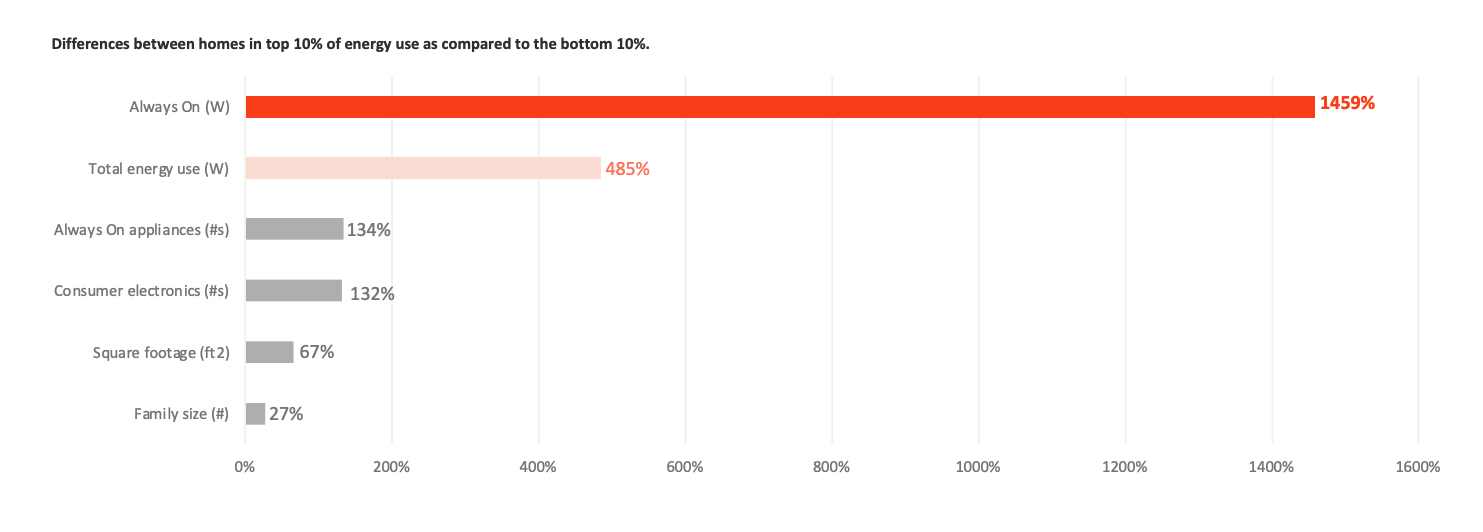
How much impact do these homes have? It’s big. If the top 10% of homes (those with highest Always On rates) could reduce their Always On usage to the median of 350W, it would cut overall energy usage in the U.S. by 10%, save $18B annually, and move the country 2% closer to the goals set at the 2015 Paris Climate Agreement. In other words, if you live in a big house with more than 15 gadgets that stay on continuously in the background, your efforts to reduce energy waste could move the needle on climate change in a significant way.
2. You can help prevent blackouts
Prolonged heat waves in California in 2020 made us curious to know whether homeowners could take actions that would reduce load on the grid. In a study of 1100 Sense homes in California, we learned that 55% of electricity usage in the evening time frame, 6 to 8 pm, could be shifted to other times during the day or reduced to help prevent rolling blackouts.
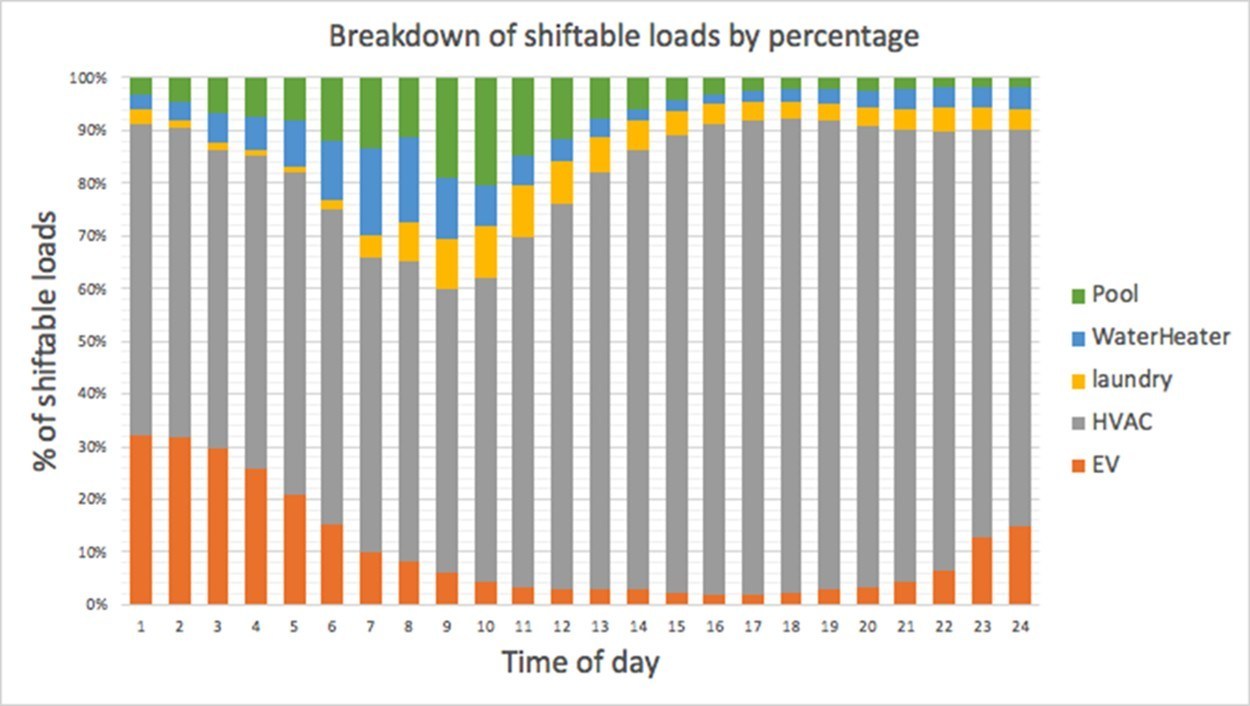
We found that 88% of consumption came from air conditioning systems. The remainder of “shiftable energy” included water heaters, laundry machines (washers and dryers), pool pumps and EV chargers. How can you use this information to help prevent power outages during extreme weather? In a heat wave, consider cooling your home in the afternoon and then turning the AC settings up at 6 pm. Take showers, do laundry and charge your EV at other times of the day or night outside of those crucial evening hours.
3. Your HVAC system could be contributing more to climate change than you think
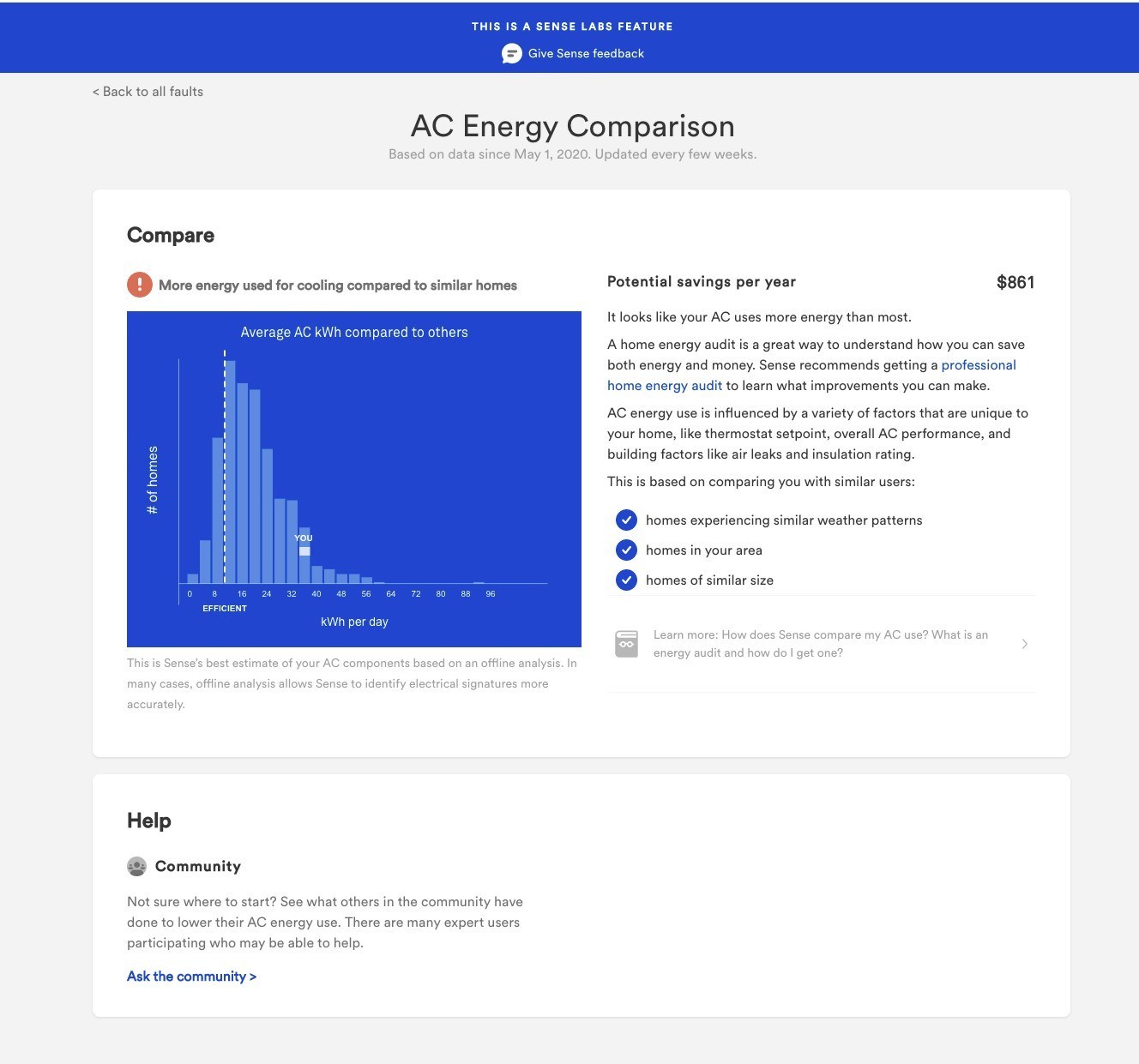
Our analysis of HVAC systems showed that 20% of Americans have air conditioning that cost the homeowner an extra $882 annually on average to keep their homes cool—almost four times as much as the most efficient similar homes. Why do some homes use more energy to stay cool than others? The culprit could be an inefficient HVAC system or a building envelope that leaks air so your HVAC needs to work harder.
The Sense Home app can tell you if your HVAC system is less efficient than similar homes. If your home is not up to par, schedule an energy audit to find out how to improve. Research your options if you need to invest in a new system. Not only will you save money; the 20% of homes with highest cooling use have a big impact on the nation’s energy picture, accounting for 45% of all cooling consumption nationwide. Updating these least efficient homes could save 8% of US residential electricity usage overall and eliminate nearly 52M tons of CO2 emissions annually.
4. Solar homes can waste energy, too
Most solar homeowners produce more solar energy in the middle of the day but need to use electricity throughout the day and evening. As a result, Sense data showed that more than half (55%) of the electricity generated by solar panels goes back to the utility grid, on average, with less than half (45%) directly used to power the home’s day-to-day needs. We were surprised at this statistic, too!
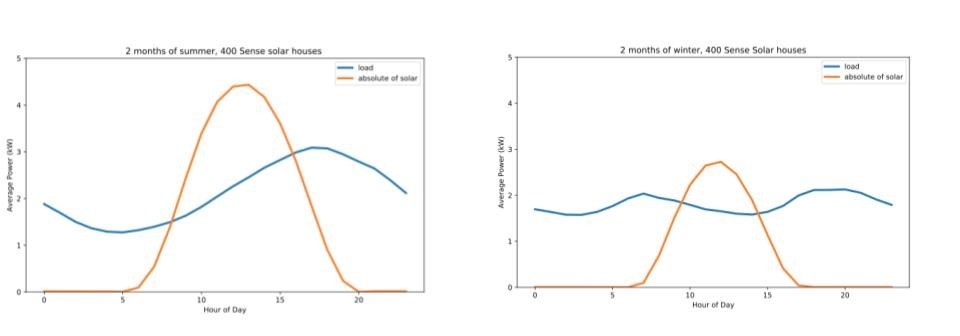
Above: Solar production is highest at midday but we do a lot of energy intensive activities in the morning and evening hours, when we make meals, stream movies and run appliances like dishwashers. These two curves show summer (left) and winter (right) solar production compared to electricity usage. Note that electricity usage peaks in the evening in the summer.
To take advantage of most of your solar power, schedule appliances during peak solar hours, including your washing machine, dryer, oven, dishwasher, and stove. Charging electric vehicles (EVs) consumes a lot of power, so solar homeowners should make it a priority to charge their EVs during the day using their solar power. If your utility uses time varying rates, it’s even more important to take advantage of your free solar power or consider investing in a battery to store it for later use.
5. Your choices really do matter
We’re returning to our Always On analysis to share insights for every home. For the average home, 23% of electricity goes to devices that keep using energy after they’re turned off. Homeowners pay approximately $308 per U.S. household annually to keep Always On devices running. But it doesn’t have to be that way in your house.
We compared two Sense homes to dig into the differences. The 5000 square foot home had four residents, while the 2,000 square foot home had only two. The real difference is in the electrical devices. The 5000 square foot home had a TV, cable box and streaming device. The 2000 square foot home had four TVs, four cable boxes, and two game consoles.
The big house had a dehumidifier that ran continuously. The smaller house had an aquarium, a fan, servers, instant hot water, pool pump and security camera. The Always On usage in the smaller home with all those devices was 23x that of the bigger home, which helped push its total energy use 450W higher. So at the end of the day, big homes can win when it comes to shrinking your energy footprint! It all comes down to paying attention to your energy usage across the board and keeping it under control.
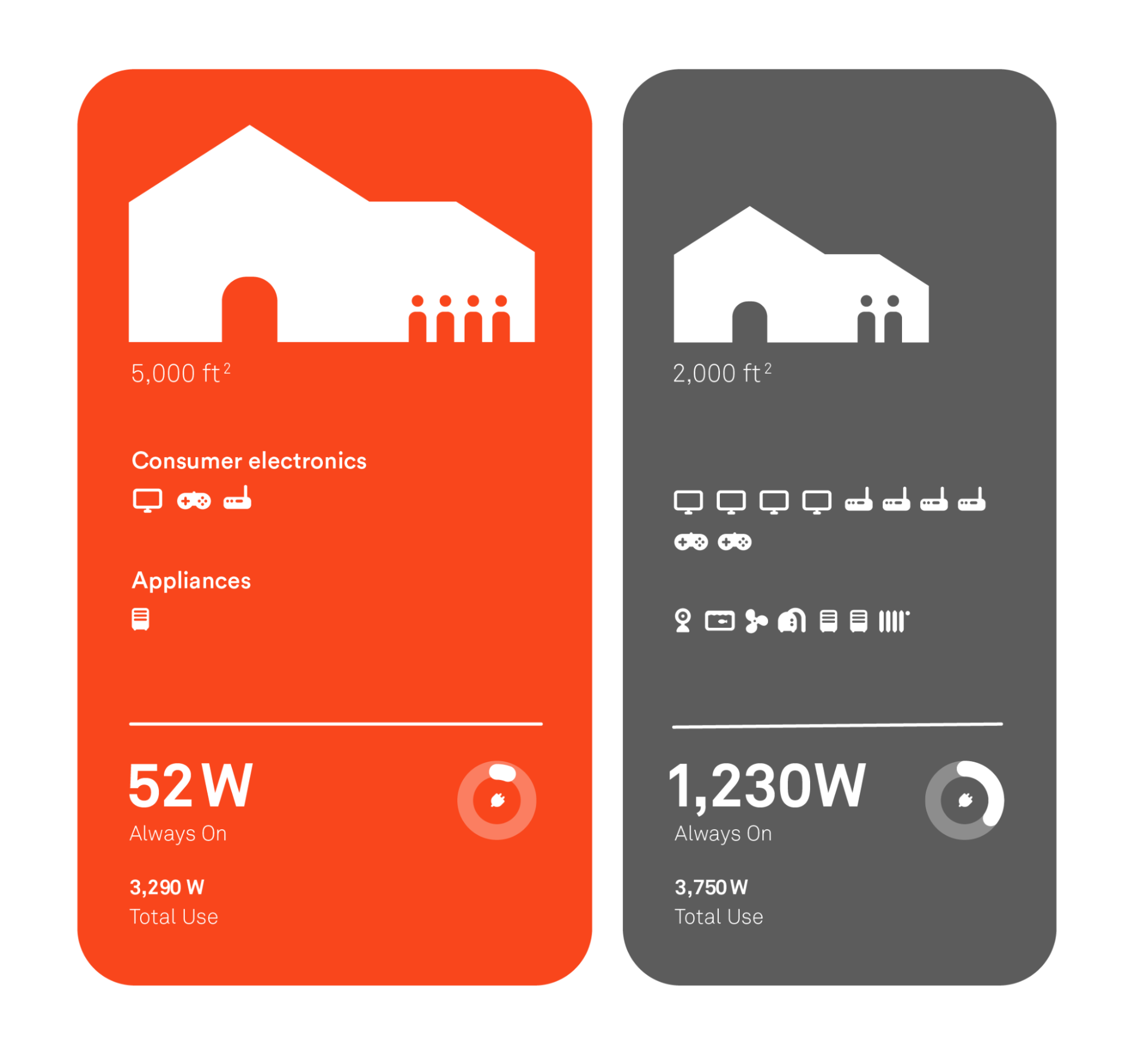
The real lesson: no matter what your home looks like, the way you live has an impact on climate change. Residential energy use accounts for roughly 20% of greenhouse gas (GHG) emissions in the United States. Understanding your own choices and taking actions to reduce energy usage saves you money and helps the country as a whole move in the right direction on climate change.
At Sense, we’ve been inspired by Rewiring America, whose climate change plan rests on the fundamental premise that we need to electrify everything in order to tap low-carbon energy sources like solar, hydro and wind. In the future, homes won’t have furnaces burning oil or natural gas; instead they’ll rely on solar panels for electricity, heat pumps for cooling and heating, electric vehicles for transportation and low-carbon energy from the utility grid.
And our homes will need to be far smarter than they are today. Most homes were designed for the 20th century, when resources were abundant and climate change was not a threat. But everything has changed. Homes of the future must be radically different — fully connected with energy systems both inside and outside the home, intelligently conserving scarce resources, and using automation to make peoples’ lives better.
Here at Sense, we’re re-inventing the smart home. With our partners, we’re even building Sense technology into the home itself, making it more accessible and convenient. We’re excited about a cleaner, better future, and energized by creating technology for a truly sustainable planet.
The post Five Surprising Insights from Sense Homes for Earth Day appeared first on Sense.
]]>The post The Future Smart Home on Earth Day 2070 appeared first on Sense.
]]>
Last week, to celebrate the 50th anniversary of Earth Day, we compared homes built in 1970 to homes today. The past half-century saw big gains in home energy efficiency. Now we’re looking another half-century into the future to imagine home life in 2070. How will our homes look and behave differently in the future? How will they care for us and the world around us?
To imagine the smart, sustainable home of 2070, we talked with two home design innovators: Steve Glenn, the CEO of Plant Prefab, and Don Powers, the founder of Union Studio. Each of their companies is moving home design forward in exciting ways with sustainability as a guiding principle. We’re also sharing our own vision for the future home.
Let’s start with Sense’s vision for the smart home. Today “smart home” means voice assistants, smart thermostats, smart lighting and other gadgets that automate or bring services from the cloud into your home. Asking Siri to play your favorite music makes life more fun and convenient, but like most smart home systems, Siri works with a limited number of other products among the dozens of appliances in your home, so it doesn’t make your entire home smarter. The same can be said for most smart home products today.
At Sense, we envision a future when smarts are built into the home itself. Rather than just a collection of smart devices, the core systems of the home will become smart. Smart homes will be able to gather intelligence about the key resources entering the home, such as electricity and water, and extend that intelligence through built-in systems to the appliances that distribute and use these resources. Through this intelligent connectivity both within the home and to resources outside, homes will be able to discover problems and optimize valuable resources far more efficiently than today.
You’ll simply tell your home “Charge my car by 7 am tomorrow,” and your home will figure out how to charge it at the least cost and lowest carbon impact. Your home will tell you when appliances and devices are behaving abnormally and could soon fail. Instead of learning about a flooded basement when you step on wet carpet, you’ll get an alert from your home when it detects the sump pump turning on or water leaking from your pipes. Your smart home app will tell you that the motor in your HVAC system is failing to start – it needs to be repaired. It will tell you when your dryer is running longer than expected – probably due to a clogged vent that could cause a house fire.
Instead of burning gas or fuel oil in your house, everything will run on electricity, with the utility grid delivering energy from green, renewable sources that reduce or eliminate carbon loading in the atmosphere. Home furnaces will be converted to much more efficient heat pumps or geothermal systems that warm your home and water, and cool the air in the summer.
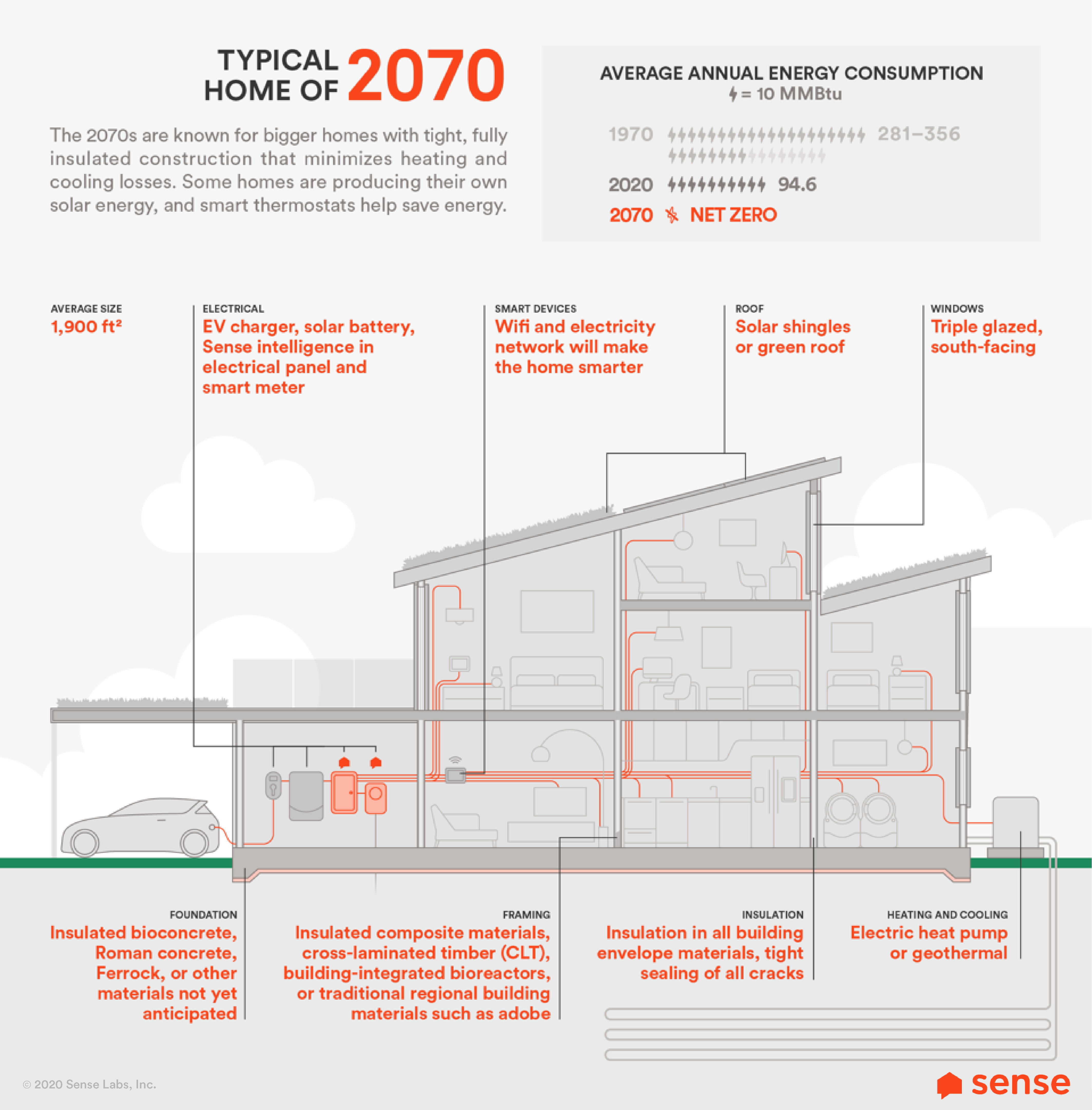
In 2070, smart homes with built-in intelligence will tell you how the home is working, alert you to repairs, and make the home more sustainable.
Your home will also remind you about the best ways to use clean energy. For instance, it might prompt you to turn on your dishwasher or washing machine when solar power is produced abundantly on your roof or from the energy grid. Or, even more conveniently, you’ll fill the dishwasher and tell your home when your next meal will be. The dishwasher will turn itself on when the energy cost is lowest, responding to information from the utility grid and your solar roof. When you go on vacation, your home will hibernate in low-energy mode until you return.
In many ways, homes will function much like today’s cars, which have intelligence built into them that alerts you about repairs or routine maintenance. Fifty years ago, cars were entirely mechanical devices. You needed to remember when to bring the car in for a checkup, and if it broke down, you needed to tow it to a service station.
Today cars are a blend of mechanical and computer technology. Indicators in the dashboard alert you to failures and remind you to take your car into the shop, where a mechanic runs a diagnostic and makes a repair. In the same way, homes will have intelligence built into them that diagnose and automate maintenance.
Smart homes will share information that makes it easier for you to take care of your home, and your 2070 smart home will take better care of you, too. Of course, your home can’t do everything. If you leave the house with the stove on, your home app can remind you, but you need to turn it off. Also, smart home systems will need to be designed to empower homeowners to make their own choices on a day-to-day basis, while automating key tasks based on home and grid intelligence.
At Sense, we expect that many of these capabilities will be integrated into homes in the coming decade, and by 2070, the capabilities will be even more seamless and sophisticated.
To understand how other aspects of the home will change in the coming half-century, we asked two innovators who are pushing the boundaries of sustainable home design to predict what the future holds. We wanted to know how homes will look, how they’ll fit into the environment, what materials they’ll be made out of and how much energy they’ll use — and, of course, did they agree that homes will be smarter?
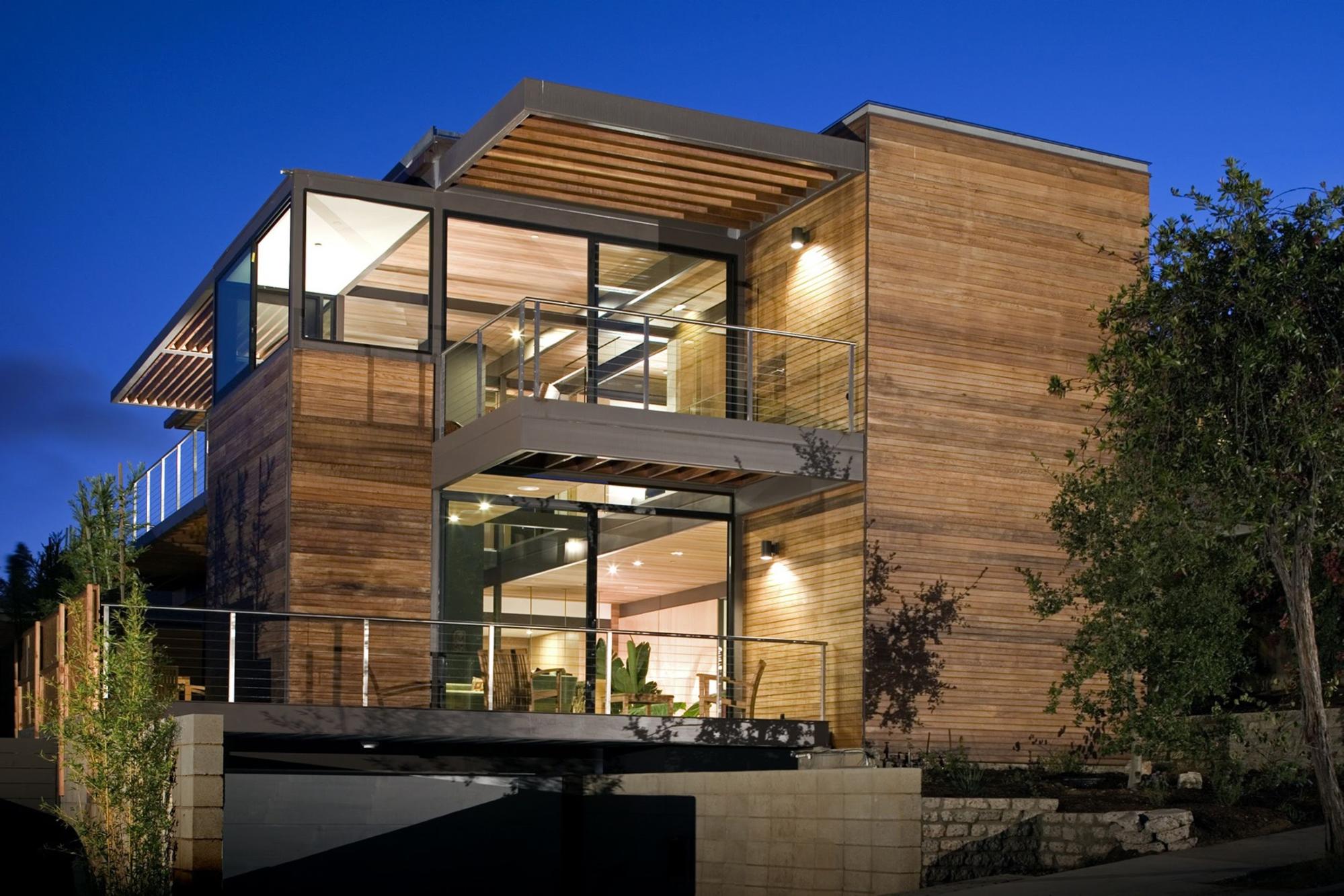
We talked with Steve Glenn, the CEO of Plant Prefab and Don Powers, the founder of Union Studio. Plant Prefab specializes in pre-fabricated designs, including accessory dwelling units like LivingHome 10, a miniature smart home with about 500 square feet of living space. This Old House profiled the transformation of Don Powers’ Craftsman cottage in Jamestown, Rhode Island, to make it net zero. His designs combine sustainability with respect for historical and regional roots.
While their answers were wide ranging, both designers agreed that homes in 2070 will produce at least as much energy as they use, and they shared our belief at Sense that smart home technology will be built right into the house itself.

Homes now have a significant, negative ecological footprint – they use more energy than they produce, they don’t save/reuse water, and they can be unhealthy. By 2070, the opposite will be true: they will produce more power than they use; they will capture and recycle water; they’ll filter air, creating healthy indoor environments. Steve Glenn, Plant Prefab

My dream is that we could rediscover how to build enduring places that people love and want to maintain, places that people have enough real affection for they couldn’t conceive of tearing down. The most sustainable home is, by definition, the one that has sustained the longest. Are we building Beacon Hill in Boston or Provincetown, MA – places that people will continually want to save and inhabit for a hundred years? Or are we building “units of housing” that will be torn down just as soon as the market determines that a newer model would sell faster? Don Powers, Union Studio
How will the home of 2070 be different from today’s home from an ecological perspective?
DP: Houses will certainly be more energy efficient at every level, both in terms of conservation and using renewable sources like solar and wind. The “net zero” home will be more the rule than the exception. Also, there will be a quantum level reduction in plastics, petroleum-based products, and generally, in any material that is not reasonably locally sourced.
Will the future home look different from today’s homes?
SG: By 2070, most building materials will likely be grown or recycled from existing materials so homes will have a much more organic, biophilic design. Cities will be much denser to accommodate a dramatically larger population, so buildings (multi family homes) will be far taller than they are today.
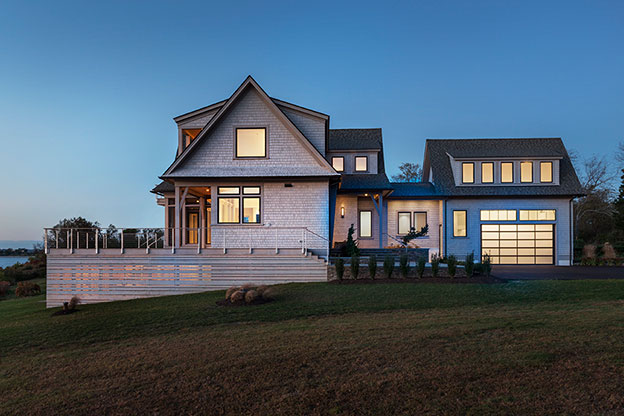
DP: On the whole, I think the average home will be recognizable and somewhat traditional. For most people. one of the functions of a home is psychological comfort and reassurance. Many architects and home designers are so enamored of cutting edge technology that they try to reflect it in the design elements of the house. This attitude overlooks the role our homes play in re-stating and confirming the values of their owners, and those values tend to change much more gradually than technology.
What kinds of materials will be used that are not common today?
SG: Structural and finish materials that are grown in labs from organic matter and that are produced from recycled products: cars, tires, or plastic.
DP: I’d ask the question the other way: Which materials won’t be in use that are commonly used today? There will be a huge move towards sustainably produced, locally sourced, “organic” materials. We’ll return to the basics such as wood, stone, brick, and plaster. Plastics, petroleum-based products and products and assemblies that require large amounts of embodied energy to make will fall out of favor. Fiberglass insulation, for example, will be replaced by natural wool, cotton, or wood fiber based systems. Vinyl siding will be banned. Drywall, which is very energy intensive to make, will be used far less, with natural FSC certified wood finishes replacing it.
What kinds of building techniques will be used?
SG: Robotic construction for framing with components for kitchens, baths, and utilities that are built in automated factories, off-site, and that are delivered by autonomous vehicles.
DP: We may see a return to local, traditional techniques that were developed as a response to local climate and locally available building materials.
How will the home relate to its community, region, or setting?
DP: I believe we’re entering a time of increased localness. A home’s design and construction may respond more to local variables than it has for this past century of abundant oil. As James Howard Kunstler writes in The Long Emergency, the “fiesta” of cheap oil has allowed us to virtually ignore the actual climate, knowing we could heat or cool ourselves no matter how inefficiently we built.
How will the 2070 home help the environment?
SG: They will create power themselves, thus not requiring power from the grid. They’ll capture and filter water (from sinks, toilets), meaning they need very little or no external water. They’ll help to filter the air, creating better indoor air quality.
DP: It is entirely possible that we will have gone beyond “net zero” and created a network of connected homes that is actually energy positive. Certainly, if we’re using every rooftop to generate solar energy, and we solve the storage (battery) problem, we will ween off fossil fuel completely.
How big will the future home be?
SG: Small! 100-200 square feet for individuals. Double or triple for families.
DP: After 60 years of growing, the average home size began to decrease in 2009. I think the home of the future will be smaller but better designed – probably less than 2000 SF.
What kinds of smart technology will the 2070 home have? How will it be integrated into the home and how will smart technology help people?
SG: There will be the same categories that exist now – smart locks, HVAC control, entertainment systems and security – only the systems will be integrated in ALL homes, including rentals, and you’ll be able to access and control from your phone, which by 2070 will likely be embedded technology in us all! Televisions will be totally flat and will cover walls, allowing for moving landscapes that help people feel more comfortable in their compact spaces.
DP: The home will be an integrated system of smart devices controlled by our handheld devices. I predict we will settle on a digital architecture and infrastructure that is simple and can support endless cycles of improvement, much like the basic smart-phone technology that is now agreed upon and supports endless innovation in the form of apps that all play by the same rules.
How will the 2070 home help the environment?
SG: They will create power themselves, thus not requiring power from the grid. They’ll capture and filter water (from sinks, toilets), meaning they need very little or no external water. They’ll help to filter the air, creating better indoor air quality.
The post The Future Smart Home on Earth Day 2070 appeared first on Sense.
]]>