The post Bright Holidays, Smarter Energy: How Watt Check Helps You Save appeared first on Sense.
]]>Did you know holiday lights can increase the average home’s December electricity bill by 10%? With heating costs already climbing this time of year, every extra dollar counts. The type of lights you use, how long they’re on, and how much your energy costs all make a difference.
For example:
- LED lights use up to 90% less electricity than traditional incandescent bulbs. Running a modest display of LEDs could cost as little as $2 for the season, while incandescent lights might run you $10–$15 or more.
- Switching to LEDs not only saves up to 90% on energy used but could pay for itself in one holiday season, depending on your usage.
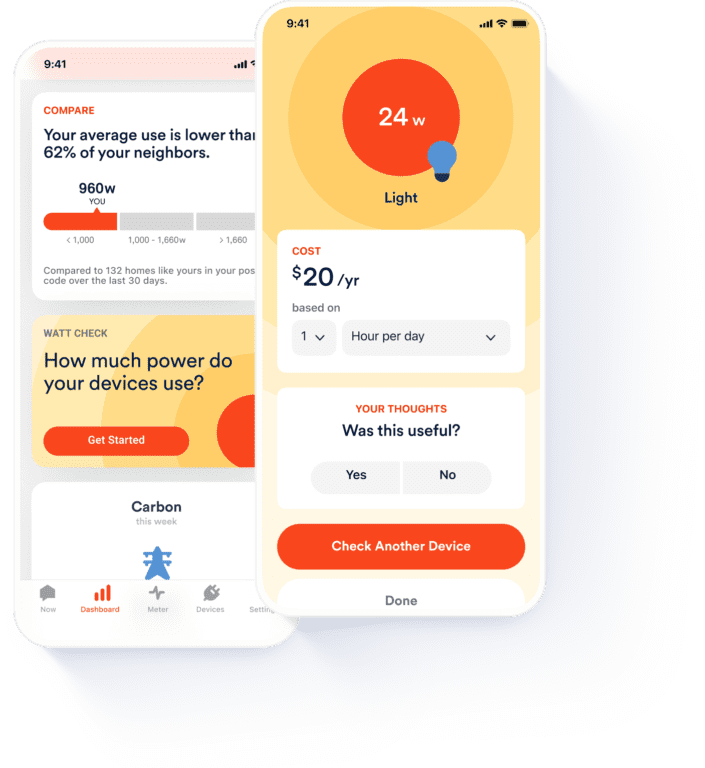
Let Watt Check Do the Math for You
With Sense’s Watt Check tool, figuring out your lighting costs is simple—and it’s personalized to your home.
Here’s how we do it:
- Open the Dashboard tab in the Sense app and find the Watt Check tool.
- Test your lights by turning them on and following the step-by-step prompts.
- Calculate your daily and monthly costs based on the number of hours you keep them on.
For example, my family sets our outdoor lights to turn on at 4 p.m. and off at 10 p.m. Using Watt Check, we learned that reducing this window by two hours saved us more than we expected. We also found that switching from incandescent to LED strands not only cut costs dramatically but allowed us to offset the higher upfront price of LEDs in just one season.
Smarter Decorating, Brighter Holidays
Using Watt Check, we’ve set a family goal to keep our December energy bill increase under 10%. This means fewer surprises, more informed choices, and a holiday display we feel great about—both for our wallet and the environment.
What About Old Light Strands?
Switching to LEDs may leave you with old incandescent strands to deal with. Here are a few eco-friendly options:
- Recycle them: Many local waste management facilities, home improvement stores, or specialty scrap metal recyclers will accept them.
- Donate them: Schools, thrift stores, or community organizations might reuse them.
Whatever you choose, remember that small decisions—like recycling lights or switching to LEDs—make a big difference for the planet.
Celebrate Smarter
With Sense and Watt Check, you can create a holiday display that’s both beautiful and energy-conscious. Make this year the start of a brighter, more efficient tradition for your family—and enjoy the holidays without worrying about your energy bill.
Happy holidays from my family to yours!
The post Bright Holidays, Smarter Energy: How Watt Check Helps You Save appeared first on Sense.
]]>The post Small Steps, Big Impact: Sense Employees Share Their Green Resolutions appeared first on Sense.
]]>Big Changes at Home
Several employees are tackling large-scale home upgrades to cut energy use and shrink their carbon footprint:
- Installing heat pumps: Jono and Deanne are replacing their HVAC systems with heat pumps this spring. These systems not only lower energy bills and reduce greenhouse gas emissions but also offer consistent temperature and humidity control. Bonus: They often qualify for rebates!
- Boosting insulation: Karen recently improved insulation throughout her home and expects to save up to 20% on heating and cooling costs. She’s using her Sense system to track the difference compared to last year. Stay tuned—we’ll share her results soon!
Everyday Changes That Add Up
Not every resolution involves a major project. Many of us are focusing on smaller, everyday actions, like grocery shopping habits:
- Buying local foods: Reducing the distance food travels helps cut greenhouse gas emissions. Deanne is skipping red meat entirely, while Jono recommends choosing locally sourced meats. For shrimp lovers, Karen is cutting back while Heather suggests opting for sustainable wild Pacific blue shrimp.
- Reducing plastic waste: We’re paying closer attention to packaging. PETE (#1) and HDPE (#2) plastics are the easiest to recycle, so we’re choosing those over less-recyclable plastics (#3–7) to ensure our recycling efforts make a real impact.
Inspiration for Your Resolutions
Whether it’s a major home improvement or a simple lifestyle tweak, every choice helps build a greener future. What steps will you take this year?
Learn more about reducing your energy use with Sense insights. Discover how Sense can help →
The post Small Steps, Big Impact: Sense Employees Share Their Green Resolutions appeared first on Sense.
]]>Our advice is to think room by room, and to think about some actions you can plan for or take immediately, beyond the usual list. June is a good time to use your Sense Home app to establish a cost baseline, make small upgrades and watch for their impact, while you plan for larger future upgrades.
The post How to Save Energy in June! appeared first on Sense.
]]>All of these actions are worthwhile. But what more can we do to stay comfortable while saving energy?
Our advice is to think room by room, and to think about some actions you can plan for or take immediately, beyond the usual list. June is a good time to use your Sense Home app to establish a cost baseline, make small upgrades and watch for their impact, while you plan for larger future upgrades.
The Attic
Start with your attic. You can reduce the load on your air conditioner if you start at the top.
- Solar Powered Attic Fan(s)
Install solar-powered attic fans to help vent hot air from your attic space. This can significantly keep the attic cooler, and that makes life much easier for your air conditioner. - Radiant Barrier
You could also install a radiant barrier, which is reflective material installed in your attic to reflect heat away from your living space. This again helps to reduce heat gain, and so helps to reduce cooling costs. - Solar panels
Although your roof is not technically the attic, investing in solar is one of the best ways there is to reduce your household electricity bill. Solar panels would be a very big upfront purchase, of course, but there are many programs at the state and federal level that can help offset this cost. For such a large project, we recommend you do two things: (1) Use the Sense Home app to establish a baseline of your home’s energy use and cost, considering different seasons and future purchases (such as an electric car) and calculating potential savings against the cost of the panels; and, (2) once installed, continue to use your Sense Home app to avoid the “solar rebound effect,” which is a well-publicized usage spike of up to 28.5% in homes that install solar, which significantly reduces actual savings.
Empty rooms
On a smaller and more immediate scale, note that rooms without people offer a great opportunity to save energy and keep costs down.
- A smart thermostat can help you save if it adapts to use less AC when a room is unpopulated for hours. And you can set a programmable thermostat to slightly different temps for day and night use, if that makes sense in your household.
- You may also need to add a dehumidifier in your basement, which will help your home to feel cooler without lowering the temperature.
- Remember to turn off ceiling fans when a room is unpopulated, because fans cool people, not rooms–so if a room is empty, they are only using energy. Just be sure your ceiling fans are rotating counterclockwise, as this is what pushes the air down to cool people in the room!
Deck / patio
Many of us use our decks/patios/porches as an extra room in good weather. Is there more you can do to extend their comfort?
- Does your landscaping help keep you and your house cool? Trees and shrubs are great for this. Both trees and shrubs can also be grown in containers, if your home has no yard. And, with or without a yard, they can help define the boundaries of your outdoor living space while helping you stay comfortable.
- Have you considered installing an outdoor misting system? And don’t forget the low cost and efficiency of fans, even outside. Or adding awnings overhead or shades on the sides? These can provide privacy as well as screen the sun.
- And of course, doing as much of your cooking outside in this space as possible keeps the kitchen cool and encourages more parties!
Sense Home app can help
Finally, be sure to use your Sense Home app to measure just how much energy your devices use – and to record your savings!
Make use of the information available in the Usage reports (at your Dashboard) and the detailed device information available at your Devices tab.

You can also use Watt Check, also at your Dashboard, to measure many common devices that turn on and off easily but that may not yet be identified.

All these measurements help as you establish your baseline and then make changes so you can track your improvement!
The Power Meter, at the main menu, gives you insight into your home’s overall energy use and helps you compute cost savings as you make small or large changes.

The Meter can also help you measure usage on devices on your list of devices, to help you measure cost as well as savings over time.
Resources
How can I use Watt Check? (Sense)
Real Time Savings with the Sense Power Meter (Sense)
9 ways to save energy & reduce energy costs this summer
U.S. Department of Energy (summer savings)
U.S. Department of Energy (keeping cool)
Electricity Consumption Changes Following Solar Adoption: Testing for a Solar Rebound
Get Green Now (saving in the kitchen)
U.S. Department of Energy (kitchen appliances)
Clean Choice Energy (kitchen savings)
U.S. Department of Energy (save on laundry)
Home & Gardens (save on laundry)
Mulberry Garment Care (when to do laundry)
The post How to Save Energy in June! appeared first on Sense.
]]>The post Don’t sweat this summer’s electric bill. Sense is here to help. appeared first on Sense.
]]>Summer, especially given the rise in extreme heat in many places, also means that most of us will use electricity to keep our families comfortable and safe. A lot of electricity!
How can we plan to lower our electricity bill and save energy at the same time?
There is a lot everyone can do, and Sense can help.
Cool can be costly
- Did you know that during the summer 1/3 of the average US energy bill is spent on AC, and if you live on the southern coast it’s closer to 1/2 of your bill? The good news is that there are many ways to keep electricity costs down and still stay cool.
- Your home’s overall usage tells a very different story from what it told last winter.
- It helps to know what devices your family runs, when they are in use, and how much that costs in electricity. And that helps you make smart choices.
Start with your house
Is your house ready?
- Check that the seals around your windows are tight when you’re using the AC.
- Check that windows can easily be opened, with screens, and use outside air when it can help cool and refresh the air throughout your house during cooler times. Good airflow also ensures healthier air.
- Add curtains, blinds or window filters to limit direct sunlight during peak hours.
- Clean your home’s air vents.
- Unplug devices that are “Always on” but that aren’t in regular use.
- Use LED lights. The energy an incandescent light bulb emits something like 327º F (90% of its energy) while an LED light emits only 107º F heat.
- Reduce or strategically time your use of the oven, stovetop and kettles.
More information
Prime your AC
Is your AC primed? As with any machinery, your AC system needs regular maintenance. Keep it clean, clear, and well lubricated.
Maintenance helps keep your energy costs down:
- Schedule annual maintenance.
- Stay safe. Turn off the AC circuit breaker or unplug the unit before you access your AC system.
- Clean. Clean the filters and the condenser coils.
- Clear away any debris or anything that obstructs airflow, including furniture and drapery.
- Keep your AC in a shady spot or at least out of direct sunlight.
- Keep heat-producing devices, such as incandescent lights, television sets, or grills, away from the AC.
Smart choices also keep energy costs down:
- Most of us know that keeping the AC temperature as high as possible is one way to save money, but do you know that running the fan in your AC continuously, instead of turning it on and off as temps change, can nearly double your bill over the hottest months?
- There’s no need to cool rooms when no one is using them. If a room gets too hot, turning the thermostat down to cool faster doesn’t really speed the cooling – but it is costly!
- If you have thermostats in individual rooms, raise the temp when a room isn’t in use. Turn off AC window units when no one is in a room or when the room has cooled enough.
- Give your AC components a break, and they will not only last longer but they’ll cost less while they operate.
Use fans
A fan should be the preferred cooling method for anyone who cares about the environment … but it’s not really that simple.
Fans both enhance AC and reduce overall cooling costs. After all, a fan can run 24 hours and use less than 1% of the energy an AC system uses in 15 minutes. Like your AC, though, a fan should be used strategically.
- Fans must also be kept clean to ensure efficiency and to reduce airborne debris.
- A ceiling fan does not cool a room, but the moving air it generates helps people in the room feel cooler. So, turn up that thermostat and add a ceiling fan to save money.
- Window fans move hotter air out of a room, so position them to face outside. This also helps keep papers from blowing around a room.
- Rely on shade and the position of the sun to move cool fresh air into your home, when possible, from different sides of the house.
- And, of course, use fans at night, when the air is cool enough.
- In a pinch, a fan can even be used as a DIY AC system if you place ice or a bowl of ice water in front of the airflow, letting the cooled air circulate.
Let Sense help
Your Sense Home app includes several features that help you track how much electricity your home (and each device) uses. Sense will help you find inefficiencies or help you track savings. Here’s how:
Usage
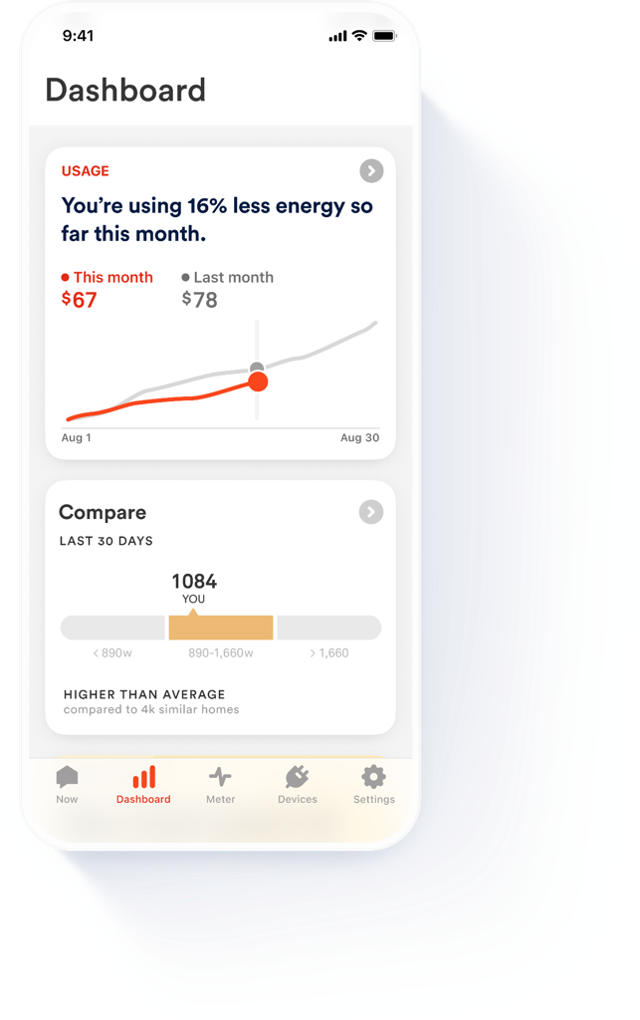
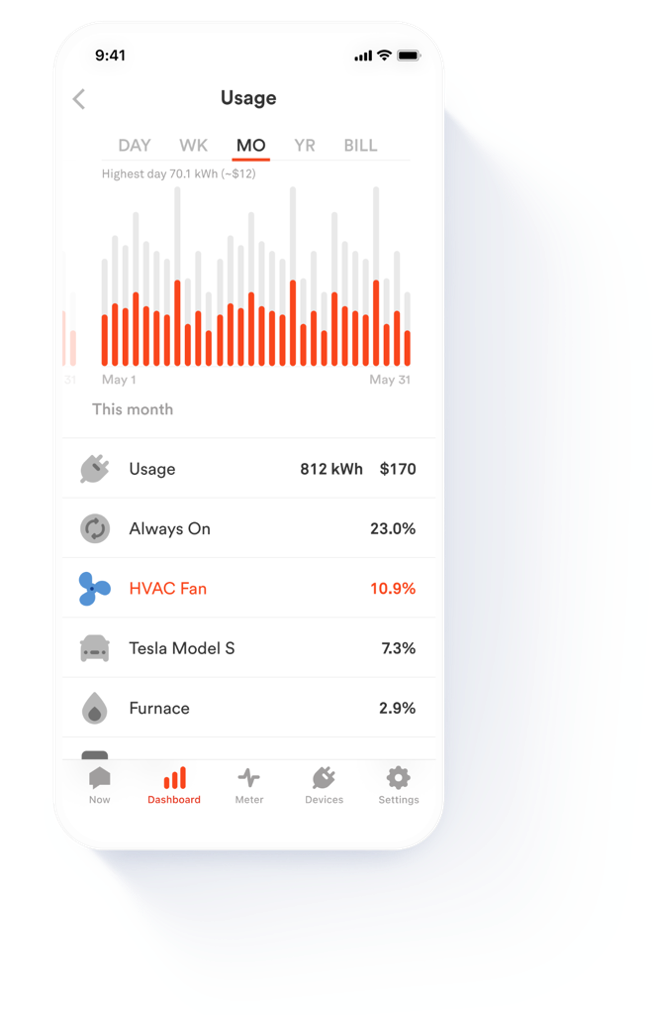
The Sense Usage feature helps you understand your overall use through the month. The trending view helps you avoid surprises that might impact your next bill.
- Click the Dashboard view in your Sense Home app for the Usage report and track your usage as it trends through the month.
- Now, click the arrow (top right) to track usage device by device. Select a device or appliance you want to track and click on its icon, then select an increment of time (Day, Week, Month, Year or Bill).
Meter
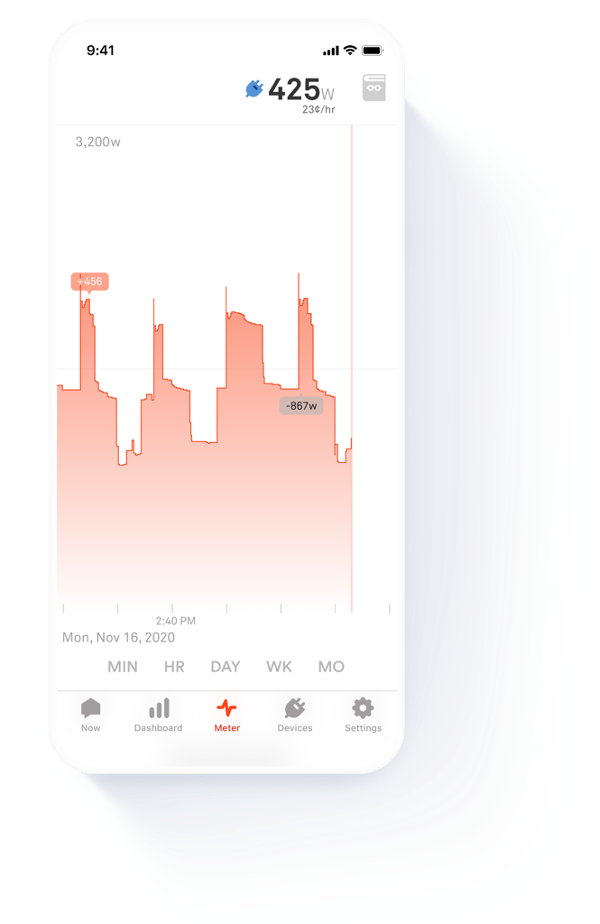
The Meter view in the Sense Home app lets you review and compare usage at different time intervals.
- Turn a device on, wait a few seconds, then turn it off and see the change.
- Calculate the difference.
Time of Use
Your electricity cost may vary by season or time of day if your electricity provider uses rate zones.
- The TOU feature lets you fully understand what a provider charges and how much energy your home is using when costs are highest – and lowest. And this knowledge, of course, is invaluable to helping you take action to reduce your usage more diligently during peak hours or threatened brownouts.
- Set as many TOU rate zones as you need.
The post Don’t sweat this summer’s electric bill. Sense is here to help. appeared first on Sense.
]]>The post Five Ways to Reduce Your Energy Bills This Fall appeared first on Sense.
]]>A professional home energy assessment can assess how well your home holds in the warmth generated by your HVAC, furnace or electric heating. With tools like blower doors, combustion analyzers, and infrared cameras, your energy auditor will take measurements and make calculated suggestions based on their readings. They’ll also ask about your daily habits in the home. Making your home tighter will lead to significant winter energy savings.
Aside from heating and cooling, there are plenty of ways to make the rest of your electricity usage more frugal, too. The average electric utility bill is more than $1,600 a year, and we know from Sense data that it can be substantially reduced by identifying waste and eliminating it. Start by using Sense to audit your home’s electrical usage. Are there opportunities to cut back usage for your whole home or individual devices? Now is a good time to investigate your Always On usage, and check out the Dashboard and Devices tabs for detailed data on your home. Most likely you will discover many ways to conserve, but here are a few ideas to get you started.
1. Make your lighting more efficient
With longer nights ahead, now is a good time to swap out any remaining incandescents or fluorescents in your home and replace them with LEDs (and be sure to check out our Philips Hue Integration for even deeper insights into your lighting efficiency. Don’t forget to look up at the ceiling and outside. Those out-of-the-way lights can get overlooked. Replace them with more energy efficient bulbs too.
2. Look for hidden heating costs now
When you switch over from cooling to heating in the fall, you can handle some routine maintenance yourself but you’re likely to need help from a professional in an annual maintenance visit that can pay off in more efficient heating all winter. A thorough service could include a long list of items, such as:
• Checking your thermostats for proper operation
• Changing air filters in HVAC systems
• Covering the AC condenser to protect it
• Cleaning the heat exchanger
• Testing, lubricating and cleaning the blower motor, and making sure the blower access door is tight
• Inspecting the vent system and chimney, as well as analyzing the combustion gases
• Making sure fresh air intake is not blocked
• Replacing the filter and nozzle on oil furnaces
• Checking wiring for damage or corrosion
• Checking burners for proper ignition and flame levels
• Making sure the drainage system is operating properly
Space heaters are an expensive approach to keeping your home warm. Find the safest and most energy-efficient models, and put heaters on timers so they’re not running continuously after you’ve left the room or the house. Smart plugs like the TP-Link Kasa are a simple, inexpensive option to control the heater directly from the Sense Home app or via voice control with Amazon Alexa or Google Assistant.
3. Cut down your Always On load
This is also a good time to take a deep dive into your Always On load and get rid of your energy vampires. Follow this guide to see how low you can go. Sound bars, cable boxes, game consoles, and computers are just a few of the devices that can waste energy in idle mode. If you’ll be spending more time inside this fall, streaming shows or playing games online, invest in smart power strips that turn everything off—entirely—when you walk away. And look around the house for anything that’s plugged in but not used, like an old TV or computer in a spare bedroom that’s trickling electricity all the time. You may be surprised at how many vampires are lurking in your house!
Sense has analyzed Always On data across thousands of homes and found that it accounts for 23% of the average home’s energy bill. If you cut your Always On in half, you’ll have $150 to put toward a holiday present for someone you love.
4. Maintain your appliances
Take the time to vacuum the summer’s dust from your refrigerator’s coils to improve efficiency. Consider whether it’s time to get rid of older appliances and replace them with new Energy Star-rated appliances that use less electricity. Make sure your washer and dryer are operating efficiently.
5. Dig into the data
Sense has data export functionality in the Web App. If you’re more technically inclined, this can be a great resource for even deeper analysis of your Sense data. The possibilities here are nearly endless, with a little processing effort on your part. Wrangle that data into calculating exact ROIs from improvements suggested in your energy audit, itemize your greatest energy hogs and analyze the cost-benefit of replacement, calculate long-term losses from your always-on devices — the list goes on!
Be sure to check out the discussions in the Sense Community. We’ve been impressed by the advice, smart home integrations and ingenious hacks our community members have shared there.
With a little bit of effort now, your fall energy tune-up will save you money and conserve energy during the winter months ahead.
The post Five Ways to Reduce Your Energy Bills This Fall appeared first on Sense.
]]>The post What are Demand Response Programs and How Do They Work? appeared first on Sense.
]]>What Is a Demand Response Program?
Demand response programs—also referred to as peak rewards programs or rush hour rewards—provide incentives for you to lower your energy use at periods of peak demand. This is the time of day when customers are using the most electricity. It is most common between June and September between 2-7 p.m. when people rely on air conditioning to stay cool. Peak demand can also occur during cold days when customers run their heating systems.
High demand for electricity requires more supply, which leads to higher energy costs for all users. By reducing the demand for electricity during certain times, demand response programs help cut prices and save energy.
While these types of programs used to only be for large businesses trying to save energy, they are now available for consumers to participate in at home as well.
Why Are They So Important?
Demand response programs provide many benefits to consumers, utilities, and the community as a whole. According to Lea Lupkin, Solutions Lead, Energy Services here at Sense, “These programs help reduce the need for ramping up dirty ‘peaker plants’ to meet extremely high demand. This benefits everyone and helps keep energy costs more affordable for all.” Environmental Defense Fund calls these programs “a triple win: savings for customers, lower costs for electric utilities, and cleaner air for all.”
By reducing energy in your home through demand response programs, you can minimize your carbon footprint while also reaping financial rewards. It also means that electric utilities can use clean, cost-effective energy instead of ramping up more expensive, often fossil fuel sources of energy. Finally, demand response programs play a role in making the electricity grid more stable and affordable by shifting demand to meet supply.
Demand response programs also result in consumers being more mindful of their energy consumption. According to research out of the UCLA Luskin Center for Innovation, demand response programs result in overall reduction in energy use—not just a shift in consumption during peak hours. This is good news considering the critical need to address climate change.
How Do They Work?
When energy demand increases, your utility or a third party managing the demand response program may notify you, while other programs are completely automatic. Many of these programs use apps now, so you will receive an alert or update on your phone or other device.
You may be asked to reduce your energy usage for a brief period of time (usually 1-4 hours) by taking some or all of the following actions:
- Adjust your air conditioning or heating. Reduce your thermostat to a temperature that you are still comfortable at. One trick is to pre-cool your home in the morning by lowering the thermostat 2-3 degrees than normal. Then later in the day (the exact time depends on where you live and what the demand response program suggests), set your thermostat 3-5 degrees higher than normal.
- Turn off lights. Manually turn off lights and/or use timers to switch them off.
- Postpone chores. Do the dishes and laundry before or after peak times, such as after 8 p.m. or on the weekend.
- Reduce plug load. Unplug devices that are not being used, since many devices draw power even when they are off.
- Use smart plugs. Plug electronic devices into smart plugs to prevent them from consuming more energy, even when they are off or in standby mode. Schedule your smart plugs to turn off devices during peak demand hours.
- Charge your electric vehicle (EV) strategically. Adjust your car’s charging time to off-peak periods or install a smart charger to automatically switch off the charger when peak hours begin. Some EVs even have an “intelligent charging” feature.
These programs are usually easy to do and will hardly impact your daily activities. “Some are completely automated, and some only may have a few peak events over the course of a year during the most critical peak times,“ explained Lupkin. Indeed, some of the programs connect pre-approved smart home technologies, such as programmable thermostats, electric car chargers, swimming pool pumps, and water heaters, that are set to automatically turn off or turn down to conserve energy for a few hours or less.
In most cases, you will receive financial rewards for your energy conservation efforts. This can look like a rebate on your electricity bill, points that you can trade in for cash, or other types of prizes.
What Types of Programs are Available?
There are many demand response programs available to homeowners. Some programs allow you to choose how to save energy in your home, while others focus on only one device at a time like smart thermostats, EV chargers, water heaters, or air conditioners.
According to EnergySage, the most common type of program for homeowners is air conditioning cycling. During a demand response event, your air conditioning unit will run for only 20 minutes each hour. And you get paid for participating in this program. Thermostat programs are also popular, with many utilities offering thermostat demand response programs, at a minimum. Many utilities allow you to enroll in the program when you purchase a smart thermostat, even offering rebates for additional savings.
There are also different seasonal programs. Rush Hour Rewards, for example, used to only offer their program in the summer, but expanded to include natural gas during the winter. To participate in Summer Rush Hour Rewards, you need to have central air conditioning controlled by a Nest Learning Thermostat and for Winter Rush Hour Rewards, you need an electric heating system controlled by a Nest Learning Thermostat.
With smart home technology gaining traction, expect to see more demand response programs being offered. Lupkin predicted, “As more people get electric vehicles and smart devices, these programs will become more mainstream.” She also explained how Sense can help enable these changes as well. “With Sense, users can see what is running in their homes in real-time, so when they get alerts they can act on them more easily.”
How Do I Participate?
Demand response programs are offered by either utilities or third-party providers, also called aggregators. If you are interested in participating, start by asking your local utility. If they don’t have a program, they may direct you to providers in your area. If you have trouble locating one, then contact the public utility commission in your state and ask them to pave the way for demand response programs.
Here are some notable programs currently available:
- OhmConnect: As a Sense partner, OhmConnect pays people to reduce their energy use one hour at a time. They currently offer programs in New York, California, and Texas.
- GridRewards: An award-winning, free app that tells customers when and how to reduce energy use and helps them earn cash payments for doing so. Available in New York, California, and Texas.
- Ecobee: The smart thermostat programs offer features to help customers save energy while enhancing comfort. Personalized energy recommendations are delivered by considering local weather, home occupancy, and variable electricity rates to shift energy usage accordingly.
Be sure to take advantage of demand response programs in your area so you can save money, save energy, and help benefit your entire community.
The post What are Demand Response Programs and How Do They Work? appeared first on Sense.
]]>The post How You Can Start Benefiting from the IRA (Inflation Reduction Act) Today appeared first on Sense.
]]>Bringing the fight against climate change home
The IRA empowers you to make changes in your energy use. It was designed to help you invest in upgrades you may have considered before but felt were too expensive. And while we’ve seen energy-efficient savings programs in the past, the IRA provides value on a much bigger scale.
In the grand scheme of the clean energy economy, this is a big deal. “The residential sector is a really critical piece of the emissions reduction puzzle,” says Brandon Dyer, Sense’s Senior Manager of Regulatory Affairs. “In order to get the full value out of the IRA, residential customers really need to take action themselves.”
The IRA is a win-win: you can take advantage of the tax credits and rebates to upgrade your home and combat one of the largest contributors to climate change.
The IRA’s tax credits are already here
The two ways to benefit from the IRA are through rebates and tax credits. But at this time, only the tax credits are available, and they’re planned to be in effect for the next decade.
There are two main credits available for residential consumers:
- Energy Efficient Home Improvement Credit
- Residential Clean Energy Credit
While rebates focus on providing you with direct refunds, tax credits are designed to offset any taxes you might owe. The rules and requirements vary by credit, but the IRS created a comprehensive FAQ sheet to help you understand qualifications and how the credits work.
If you’re ready and eager to plan for your clean energy future, we’ve gathered a handful of moves you can make right now to ensure you’re getting the most out of every IRA benefit.
4 actions you can take to benefit from the IRA’s tax credits
Any cost-saving steps you take towards energy efficiency come with the bonus of making your home more enjoyable in the long run. The IRA helps you make those changes affordably, but it’s always good to know where to start and what makes the biggest impact. Looking to save money and energy? Start here.
Action #1 – Get an energy audit
On a base level, an energy audit lets you identify the least energy-efficient places in your home and plan accordingly. But it can be more than that. “An energy audit sets the stage for opportunities in the home,” says Dyer. “Some things you can fix with little or no cost. But it also helps a customer prioritize where spending the money might have the biggest impact on energy consumption or comfort or health and safety in the home.”
A professional audit shouldn’t cost more than $150. Many utilities will offer free audits for their customers — but it’s up to you to find out what’s available in your area. They may also offer enhanced incentives alongside an energy audit, such as rebates or no-money-down financing. Federal and state weatherization programs can even help you cover essential non-energy home repairs, clearing the way for you to then implement the energy efficiency solution. For example, fixing a leaky roof so you can add insulation to your attic.
You can prepare for an audit by listing any issues you’re already aware of. For example, any noticeable drafts or leaks, older appliances, or even months when your bills are higher than usual.
How you benefit
The home energy audit tax credit lets you claim 30% of the costs up to $150.
What to do
File the correct form and ensure that you use an auditor with the correct certifications and that you receive a report.
Action #2 – Weatherize
According to Dyer, weatherization isn’t just a good idea — it’s compulsory in cutting your home’s energy waste costs. “Weatherization is foundational,” he says, “and your home energy report will show you where to start.”
Weatherization actions include:
- Insulating your attic
- Adding weather stripping around doors and windows
- Fixing leaks in your HVAC ducts
- Investing in a water heater insulation blanket
- Upgrading windows and doors
- Installing a programmable or smart thermostat
How you benefit
The Energy Efficient Home Improvement Credit lets you claim a maximum of $1200 each year with:
- A limit of $250 per door, $500 total
- $600 limit for windows
- No limit beyond the $1200 for insulation and air sealing materials or systems
What to do
File the right form and ensure that you meet all requirements. Doors and windows must meet ENERGY STAR standards, and insulation and air sealing materials must meet International Energy Conservation Code (IECC) standards.
Action #3 – Upgrade your appliances, heating/cooling systems, and more
For now, you can focus on receiving tax credits for efficient heating and cooling systems, water heaters, and any other qualifying product listed by the IRS. However, be on the lookout for rebates that help you with the electrification in your home, including transitioning to energy-efficient washers and dryers.
How you benefit
Since this is also part of the Energy Efficient Home Improvement Credit, you receive up to $3200 in tax credits. This includes appliances to a max of $600 and heat pumps and biomass stoves, and boilers up to $2,000 per year.
What to do
Make sure that you meet all the requirements, and when filing taxes, fill out the right form.
Action #4 – Invest in renewable energy upgrades
The Residential Clean Energy Credit lets you install renewable energy into your home while helping you save on the cost. The credit covers solar electric panels, solar water heaters, wind turbines, geothermal heat pumps, fuel cells, and battery storage technology.
How you benefit
You’ll save 30% on qualified renewable energy installation, including:
- Labor costs for onsite preparation
- Installation
- Piping or wiring to connect it to the home
- Equipment
The included labor and installation costs are a standout feature. It’s unique for federal dollars since other programs have only offered to cover the material cost of solar panels.
There is no limit, but the credit may not exceed what you owe. However, you can carry forward any unused credit for upgrades in the future.
What to do
Before investing, determine whether you meet all qualifications and requirements, and fill out the correct form at the time of filing your taxes.
Stay tuned for rebates
Right now, we’re all playing the waiting game when it comes to IRA rebates. They’re expected to land in late 2023, and each state will need to determine qualifications before the money starts flowing. But consumers can expect offerings like:
- Rebates for insulation, air sealing, and ventilation.
- Rebates for electric wiring upgrades.
- Rebates for ENERGY STAR certified electrification (converting to machines that use electrical power) equipment — such as washers, dryers, and heat pumps.
Everyone will benefit from IRA rebates, but if you have a lower income, you’ll save even more. Until the rebates arrive, you can take advantage of the numerous tax credits and any existing Federal rebates and incentives so you can begin reaping the rewards of a cost-and-energy-efficient home ASAP.
Even with all this information at hand, IRA benefits can still be hard to fully grasp. Luckily, every day brings new rebate and tax credit resources, in-depth guides, and other helpful tools to help you make the right choice for your household. For a great example, check out the Department of Energy’s (DOE) Energy Savings Hub. And make sure to keep an eye out for new resources about the IRA — and more — from us.
The post How You Can Start Benefiting from the IRA (Inflation Reduction Act) Today appeared first on Sense.
]]>The post Why Energy Efficiency is a Win-Win for Consumers and Utilities appeared first on Sense.
]]>Utilities often offer programs and tips for saving energy — as well as things like free light bulbs, rebates, and other conservation perks. These initiatives are funded by utility programs because they want to save energy too. You see, electric utilities are part of a bigger, complex energy market. And energy efficiency programs fit within that market to incentivize deregulated utilities and help utilities follow state mandates. So, when you’re more energy efficient, it benefits both you and them.
The energy market is complex
There are two notable misconceptions about the energy market. The first is thinking that your utility provider is at fault for any cost fluctuation. The second is that they make an excessive profit when demand is high. However, regulators are there to make sure utilities are not making money on energy.
Matt Nelson, former Chair of the Massachusetts Department of Public Utilities, says, “Regulators spend a lot of time making sure utilities don’t make money off of customers using more energy. They want the goal to be helping customers optimize their use so they’re happy.”
Consumers aren’t always aware of the complexities or the variety of factors affecting the energy market. But here’s a brief look at how it works:
The three components of your energy bill
Nelson says, “There are three major components that make up a customer’s bill — the energy cost, the delivery or distribution costs, and what people often refer to as public policy costs.” Each of these components is a part of the energy market, and has a role in determining what you see on your bill.
- Generators: These are the companies that own and operate power plants. The plants use fossil fuels, like coal and natural gas or renewable energy, like hydropower, wind and solar to generate electricity. Energy demand fluctuates, and when demand is exceedingly high, generators bid to produce more energy at a cost they can’t pass on to you in the near term. When prices increase for consumers, it’s because the long-term cost of production has increased and regulators have approved of generators passing that increase on to you.
- Distribution companies: This is your electric company or utility — the people that send you your bill. They’re the main source for your energy market interactions. Regulators oversee distribution companies to ensure they’re operating safely and reliably. Their distribution rates are fixed and don’t fluctuate with an increase in the cost of generation.
- Public policy: Public policy costs cover a variety of things, such as a charge to ensure safety or fund cost-effective energy efficiency programs. Costs may be anything from a Renewable Energy Investment Charge to a Load Management Charge and will depend on the state and your utility.
Why your utilities sponsor energy-saving programs
Energy efficiency programs are there to benefit customers, but they help utilities as well. You’re in this together. The programs help utilities by “freeing” up energy (i.e. reducing energy use), which decreases the need to build power plants and power lines. Instead, utilities earn more when a sufficient number of people participate in an effective (or proven) energy program and they demonstrate the avoided energy use. But utilities are both incentivized and mandated to offer energy efficiency programs as well. Here’s why:
- Deregulation and energy efficiency programs: As of 2023, 15 states have deregulated electricity and 26 have deregulated energy. Deregulation gives consumers their choice of energy providers. Since companies must compete for customers, offering better services is a must. Energy efficiency programs help lower energy costs and add extra comfort, making customers happier. “The idea is that the distribution utility no longer cares about generation or sales,” Nelson says. “The regulator is swapping out ‘building more plants’ for ‘customers saving money at home’ as the way to make additional profit.”
- State energy efficiency mandates: Many states require utilities to offer energy efficiency programs. The Department of Energy describes these programs as a way to “ensure that utilities get a fair return on investment while giving a fair rate to the customer.” Some states set goals in line with meeting state policies and require a minimum performance that utilities must meet to earn any incentives. Other states require utilities to act in the customer’s best interest. And the utilities have incentives to educate the customer and offer them efficiency equipment.
- Increased involvement in energy efficiency programs is also a win-win: Increased participation in energy efficiency programs has wider-reaching benefits for communities. For example, reducing demand can help high-usage areas avoid rolling blackouts like the ones that occurred in California. When more people use less energy, your community can save costs by not having to build new plants. Another benefit is that peaker plants — those brought online to meet excess demand — are almost always fossil fuels, so it’s not as clean. When communities work together to reduce energy, it will have a positive impact on the environment that provides a benefit for everyone.
Where Can You Find Energy Efficiency Programs, Rebates, and Incentives?
Energy efficiency programs often have incentives or rebates. For example, you can buy a new energy-efficient washer and get a rebate for that purchase. You can also increase the overall energy efficiency of your home and apply for a tax break when you file next year. And the newly-introduced Inflation Reduction Act (IRA) features extensive tax credits and benefits for residential energy efficiency.
Find incentives and rebates by asking your local utility or your local or state government. The Department of Energy offers weatherization assistance and lists rebates, tax credits, and savings programs. In addition, many home improvement or appliance stores will let you know about rebates that are available.
To better target what rebates and incentives will help you and your home’s unique needs, get an energy audit. You may be able to get an energy audit through your local utility. If not, there are other tax credits that can offset the cost of getting one. Another tool is technology that assesses the usage in the home.
Energy efficiency is worthwhile for everyone
In the end, energy efficiency always pays for itself, whether you’re a homeowner or a utility.. And by offering energy-saving programs and tax credits, utilities can accelerate that benefit. So what are you waiting for?
The post Why Energy Efficiency is a Win-Win for Consumers and Utilities appeared first on Sense.
]]>The post Ingenious Clothes Dryer Hacks From Two Sense Customers appeared first on Sense.
]]>Matt Ledbetter used Sense to troubleshoot a problem with his Whirlpool Cabrio dryer. He noticed that the dryer was running much longer than usual, and the clothes came out dry but wrinkled. When he looked at the Sense Home app, he saw that the dryer was no longer detected, signaling that something had changed. Instead of using 5000 watts when it was turned on, the dryer now appeared to be using 2500 watts. (Even when a device is not detected, you can see how much electricity it uses while running in the Power Meter view.)
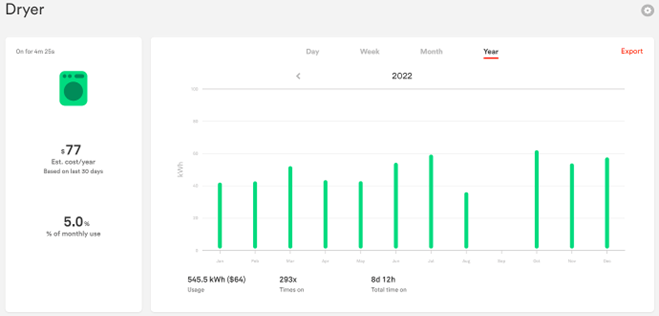
The Sense Home app stopped detecting the dryer in late August and it restarted in October after the new heating element was installed.
Matt surmised that one of the heating elements had broken in the dryer. He replaced it himself for about $40 and the dryer went back to working normally. With his sleuthing, Matt saved himself an expensive service call or dryer replacement. You can read Matt’s post in the Sense Community.
Sam Zelinka’s story caught our attention because he used Sense to figure out exactly how much energy his clothes dryer uses and what it costs. Using Sense, he discovered that his electric dryer used a little over 5000 watts when running, which translated into a cost of 27 cents per hour. But since he had time of use rates, the cost during off-peak hours was 9.2 cents per KwH versus 20.5 cents per KwH during peak times. By shifting more of the drying to off peak times, he could save about 20%.
Sam also discovered that the clothes dryer accounted for 20% of his electricity bill. His money-saving solution? Hang the laundry to dry instead, which could save the family $286 annually.
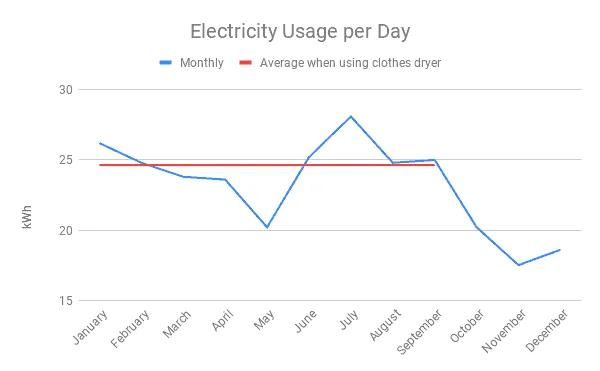
Sam stopped using the clothes dryer in October 2018 and had a 20% reduction in energy usage.
For more details, read Sam’s story at his blog, GovernmentWorkerFI. And keep looking for energy insights that turn into savings in your house with Sense!
The post Ingenious Clothes Dryer Hacks From Two Sense Customers appeared first on Sense.
]]>The post How to Make Fireplaces Safer and More Efficient appeared first on Sense.
]]>First, Check Local Fireplace Regulations
Let’s start with the basics. Before building a fire in your fireplace, check with your local codes regarding wood burning, especially if you live in a fire prone area in the west. Concerns about the health impacts of smoke and particulate matter from chimneys have led to restrictions on open fires. Particles less than 10 micrometers in diameter from burnt wood get lodged in our lungs, increasing the risk of asthma and other respiratory diseases, especially for children and older adults.
In some jurisdictions in California, for instance, open hearth wood-burning fireplaces are not allowed in homes built after 2016. In some areas most affected by smog and smoke from forest fires, open-hearth wood burning is forbidden on what they call “Spare the Air Days” in California.
In Colorado, counties in Denver and surrounding areas limit wood burning during an “air quality Action Day.” Exceptions include households where the primary heat source is wood and homes using EPA-certified wood-burning devices that limit particulate matter below a certain level.
A government-sponsored website, AirNow, will show you the air quality in your area. Several apps, including AirNow, are available for iPhones and Android devices that track the weather, including air quality, on your phone.
Ready for a Fireplace Upgrade?
The design of your fireplace can have a big impact on its safety and efficiency. Here are some options for improving the performance of fireplaces, from the most basic to the most sophisticated. (The EPA has an excellent overview of fireplace types.)
This article is focused on fireplaces and not home heating devices, such as pellet stoves or what are sometimes called “Swedish Fireplaces.” Swedish, or masonry, fireplaces are built with material that holds heat and radiates it to its surroundings over time. The exhaust gasses pass through a maze of channels before being exhausted, and the heat is absorbed into the masonry, making them very efficient heaters, but they require a significant construction project.
Chimney Balloons Can Stop Cold Air
Typical old-fashioned fireplaces leak a lot of energy and create drafts all year, especially in the winter when there is a significant temperature difference between inside and outside the home. One big reason is that most dampers are metal and are rarely air-tight even when they’re closed.
A chimney balloon is an inflatable device that fits just below the damper in your fireplace and blocks airflow. Don’t use a chimney balloon when you have a fire burning! But after the smoking embers turn to ashes, it’s a great way to save energy and be more comfortable.
Research in the UK—where they know chimneys, chim chim cheree—shows that chimney balloons can decrease airflow through the chimney by more than 80%, which means they save energy by eliminating cold downdrafts or warm air escaping up the chimney. Chimney balloons are a little klugy to install but are worth the effort.
Consider Gas and Electric Fireplaces
Electric fireplaces can be relatively airtight and need no chimney while generating a lot of radiant heat. Their biggest downside is aesthetic since it’s hard to make an electric fire look like a real fire.
Gas fireplaces do need a chimney or some exhaust pipe. To create a cheery fire, you can use gas to start a wood fire and then turn the gas off. Gas fireplaces give off a lot of heat but burning gas produces CO2, CO, and other nasty gasses like NO. Be sure that gas fireplaces are well-vented to the outside so gasses don’t escape into your home.
Burn More Cleanly with Fireplace Retrofits and Inserts
If you love the look and spontaneity of a wood fire, fireplace retrofits to your existing wood-burning fireplaces can make them more efficient and less polluting. Retrofits typically fit inside your existing fireplace and use materials that increase the fireplace’s temperature so the wood burns more efficiently and cleanly. Some devices claim to reduce emissions by 70% or more.
Fireplace inserts are more efficient and less polluting than fireplace retrofits. Inserts fit into a traditional masonry or metal firebox and operate like a free-standing wood stove that can be used efficiently and safely. They need to be sized correctly to fit the existing space. There are wood, gas, and electric fireplace inserts.
Inserts can control the air intake and, therefore, the burn rate of the wood, making it more efficient. Some fireplace inserts come with fans or blowers that help take the heat around the firebox and distribute it to the room.

Step up to EPA Standards
The EPA does not certify or regulate fireplaces and fireplace retrofits but it does “qualify” them through a Voluntary Fireplace Program. EPA recommends that you check your state or local government and clean air organizations to determine what is legal in your area before embarking on a retrofit project.
The EPA does certify wood-burning fireplace inserts through its EPA Certified Wood Heater Database. Certified wood-burning appliances emit particulate matter below a certain level, about 4 to 8 grams per hour, depending on the type of device.
The agency has lots of good tips for burning wood, including storing wood and disposing of the ashes. Check out its Burn Wise online resource. Everything you want to know about burning wood, or roasting chestnuts, cleanly and efficiently.
With a little effort, you can enjoy cozy time by the fireplace this winter while minimizing wasted energy and keeping your family, neighbors and the air we breathe healthy.
The post How to Make Fireplaces Safer and More Efficient appeared first on Sense.
]]>