The post Smarter Charging Through Partnership appeared first on Sense.
]]>By embedding Enode’s API into the Sense Home app, we’re extending our real-time visibility in the home to the EV itself, capturing live data streams like battery status, charge rate, and usage trends across 45 brands and over 365 models. This creates a unified layer of intelligence that enables more accurate load forecasting, targeted demand response, and seamless customer engagement at the grid edge.
We spoke with Nikolai Heum, CTO and co-founder of Enode, about the technology behind their API platform, the role of integration in grid modernization, and how this partnership unlocks smarter energy management for both EV drivers and utilities.
Q: What is Enode and what are the challenges that you’re focused on solving?
Enode provides the leading API platform for connecting energy devices like EVs, chargers, solar inverters, and batteries to digital apps and services. The biggest challenge we solve is fragmentation. Every device brand has its own way of sharing data and controls. Enode removes that complexity by providing one integration that works across hundreds of devices, so energy companies can focus on building products that accelerate electrification.
Q: What makes Enode’s approach to device integration so unique?
We combine breadth and depth. Our coverage spans over 1,000 models across 100+ manufacturers, and we don’t stop at connectivity. Enode provides real-time data and control capabilities that enable advanced use cases, from richer EV insights today to smart charging and solar-aware load shifting in the future.
Q: How did you first hear about Sense, and what made you decide to collaborate?
We’ve followed Sense for years as a pioneer in home energy intelligence. Their expertise in real-time energy monitoring aligns perfectly with our mission of making energy data actionable. Partnering was a natural step. Together we can bridge the gap between awareness and control, starting with EV drivers.
Q: How does Enode’s technology work with the Sense user experience?
Sense gives households visibility into how energy is used at home. By integrating Enode’s API, that visibility now extends to EVs. Sense users can see real-time EV data like battery status, charge rate, and charging activity directly in their app. Over time, this data also creates the foundation for new features like smart charging.
Q: How will this partnership benefit EV drivers that use the Sense mobile app?
EV drivers will get richer insights into their charging, including battery status and the ability to distinguish between multiple EVs in the home. That makes EV ownership simpler and more transparent.
Q: How do utilities benefit from the adoption of Enode’s technology by companies like Sense?
Utilities gain access to aggregated, flexible load at the grid edge. Through partners like Sense, Enode enables utilities to integrate EVs and other devices into demand response programs, time-of-use pricing, and broader grid management efforts. The result is a grid that’s more reliable and resilient.
Q: How can Enode’s technology help address the challenges faced by the grid due to growing EV adoption?
Unmanaged charging can put serious strain on the grid during peak hours. Enode enables EV data and controls to be integrated into digital services at scale, creating the foundation for smart charging that shifts demand to times when the grid is less stressed or renewable energy is abundant. That helps lower emissions, reduce costs, and limit the need for expensive grid upgrades.
Q: What other types of DERs does Enode support? What use cases for device integration excite you the most beyond EVs?
Beyond EVs, Enode connects to solar inverters, home batteries, and heat pumps. The most exciting opportunities come from combining them. For example, charging an EV directly from rooftop solar or discharging a home battery to reduce peak demand. The more devices we connect, the more value we can unlock for consumers, utilities, and the grid.
Nikolai Heum is the Co-Founder and CTO of Enode. He defines the company’s long-term technology roadmap and drives Enode’s mission to accelerate the transition to a sustainable energy system by connecting and optimizing the world’s energy devices. Before Enode, Nikolai joined Monio as engineer number two, where he helped build the company through to its exit, and has since invested in and advised several Nordic startups.
The post Smarter Charging Through Partnership appeared first on Sense.
]]>The post Your Meter Should Be As Smart As Your Phone appeared first on Sense.
]]>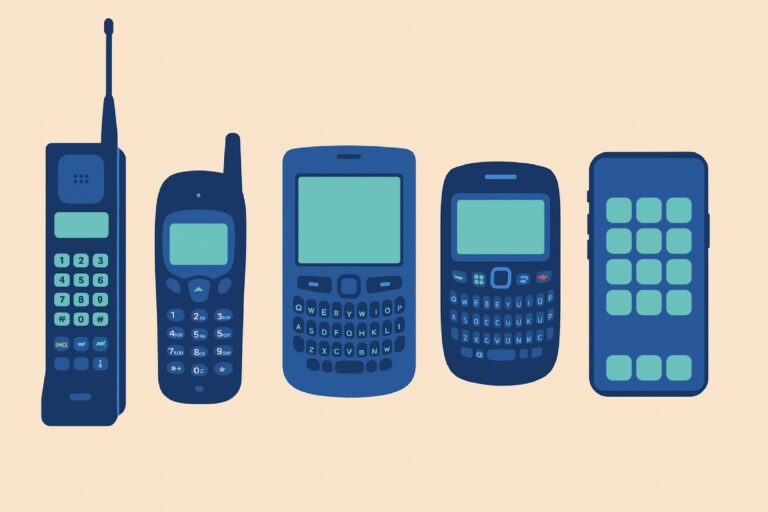
Traditional meters have been stuck in the slow lane, typically operating on past data collected every 15 minutes to offer a fuzzy snapshot of what’s happening across the grid. Today, next-generation AMI 2.0 technology is making the same leap your smartphone has.
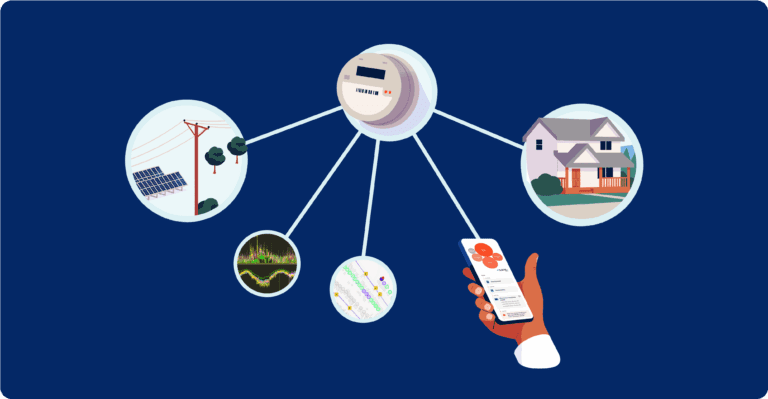
With embedded intelligence enabled by partners like Sense, 50 million times as much data as first-generation smart meters can be processed at the grid edge. AMI 2.0 meters tap into the same computing power that allows smartphones to process the high data rates they need to. And by connecting to home WiFi, they can deliver real-time actionable insights.
The result is that a meter now has the capabilities to be as smart, adaptable and beneficial as your smartphone. Moving to AMI 2.0 technology is like swapping out your Nokia 8210 for an iPhone.
Unleashing the energy transition
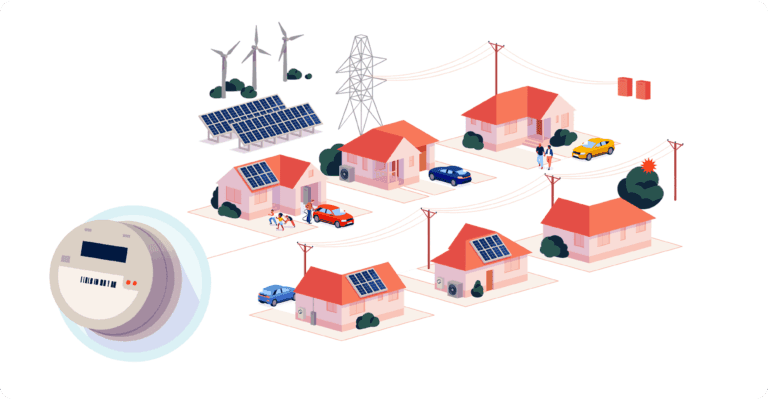
This could not come at a better time for utilities. Electricity demand is surging across the US as data centers, electric vehicles, and other demand sources are rolled out to match the needs of our modern society. At the same time the intermittency of clean, distributed energy resources calls for new approaches to grid management.
Distribution grids are not ready for this energy transition. More wires, power plants and other hardware aren’t enough to get us where we need to go. New solutions to reach consumers and deliver greater grid-edge visibility and control are needed more than ever. Thankfully, next-gen smart meter technology is here today.
AMI 2.0 technology offers the scalable and powerful network we need to unleash the energy transition affordably and effectively. Sense’s AI technology sits within these meters at the grid edge to deliver in-home intelligence in real time. For utilities this capability offers a detailed bird’s eye view of what’s happening on the system, transforming how it can be managed.
Crowdsourcing grid management
Apps like Google Maps have revolutionized how we travel in cars by crowdsourcing real-time data to provide drivers with insights on their journey. AMI 2.0 can do the same for utilities. Just like when Google Maps uses the speeds of vehicles connected to the app to identify traffic problems, a meter equipped with technology like that provided by Sense can detect unusual power fluctuations or outages and instantly report them to you. But that’s just the start.
The in-home device provides utilities with a direct line to households. Where Google Maps helps drivers avoid traffic or find the cheapest gas stations, you can use AMI 2.0 meters to alert consumers of changes in grid conditions or real-time pricing. The result is a community of users running appliances or charging EVs when prices are lowest and at times that work best for the grid.
The two-way relationship creates a whole new dynamic between consumers and utilities—one that’s interactive, responsive, and truly smart.
A grid-scale health check
AI-enabled AMI 2.0 meters let homeowners and utilities alike carry out a smart home health check on devices and how they interact with the grid. Where health apps like Oura might track your heart rate or sleep patterns, Sense uses AMI 2.0 to monitor energy-hungry devices to detect and warn you about any changes in a home’s energy consumption patterns.
The embedded intelligence within AMI 2.0 meters can analyse energy consumption up to one million times a second to detect the difference between a heat pump and a hairdryer. Apply this capability across a grid and we can transform our relationship with energy in the same way that personalized health monitoring has reshaped wellness.
The time is now!
Decisions need to be made today to take advantage of this potential, with nearly a quarter of meters in the US due to be replaced by 2030. The energy transition will happen during the lifespan of meters being installed now.
AMI 2.0 meters installed today can be updated remotely to evolve and address tomorrow’s energy challenges. Many electric vehicle drivers have experienced the value of remote updates that improve range, add new features, or optimize performance years after the vehicle first took to the road. The same is true for AMI 2.0 smart meters with embedded intelligence. They continue to grow in value and functionality long after installation.
Everyone benefits from lower costs and a more flexible grid fit for a cleaner future. Adopting AI-ready AMI 2.0 smart meters delivers the platform on which technology like that provided by Sense can deliver these system benefits for all of us.
The post Your Meter Should Be As Smart As Your Phone appeared first on Sense.
]]>The post EV Charging Is Changing the Grid. Here’s How to Get Ahead appeared first on Sense.
]]>The rapid rise of electric vehicles is reshaping the way we think about the grid—from both sides of the meter. As utilities work to meet ambitious climate mandates while keeping systems resilient and affordable, EVs are emerging as both a challenge and an opportunity.
According to the US Department of Energy, around 80% of EV charging happens at home. That’s good news because unlike most home energy loads, EV charging is highly flexible. With the right tools, utilities can turn this flexibility into real-world value: for the grid, for the environment, and for customers.
But it all starts with visibility. That’s where Sense EV Analytics comes in.
Meet Sense EV Analytics: Smarter EV Intelligence From the Grid Edge
EV Analytics leverages Sense’s distributed edge intelligence to detect and analyze home EV charging regardless of vehicle make or charger type. By applying AI and machine learning to high-resolution waveform data, EV Analytics gives utilities unprecedented clarity into when, where, and how much EVs are charging.
And that clarity enables action.
Sense identifies Level 1 and Level 2 charging events with minute-by-minute start/stop timestamps and 5-minute kW load data. This information feeds directly into key utility operations—from managed charging and distribution planning to load forecasting and customer engagement.
- Detect Charging at the Grid Edge
Leverage meter-embedded AI that analyzes high-resolution waveform data—eliminating the blind spots and delays of cloud-only or 15-minute interval data approaches. - Lower Program Costs and Expand Access
Recruit and enroll more customers into managed charging programs with new options for EVs using Level 1 chargers. One solution, broad coverage, lower acquisition costs. - Support All EVs and Chargers
Deliver EV insights regardless of make, model, or charger. Sense’s waveform-based detection is vehicle and charger agnostic—removing the enrollment friction created by telematics or proprietary hardware. - Adapt to the Fast-Changing Grid
As new EVs are added to the grid every day, Sense keeps pace offering continuous detection and insights to help you adapt your planning and operations in real time. - Build a Flexible, Scalable Foundation
Support multiple meter communication protocols (Cellular, Mesh, WiFi) and integrate seamlessly with utility platforms. Sense enables a software-first strategy that’s ready to scale with your AMI 2.0 rollout. - Unlock Dispatchable Load
EV charging is flexible and Sense helps you tap into that flexibility. Shift load to off-peak hours with real-time visibility that enables smarter demand response and grid reliability strategies.
Why Grid-Edge Matters
Today, most utilities rely on a patchwork of EV data sources—some delayed, some disconnected from actual meter locations, and many with significant data gaps. Further, most software approaches rely on cloud models that can’t keep up with the real-time grid. That makes planning difficult, and limits the success of managed charging programs.
EV Analytics changes that. By detecting when an EV is added to a home, utilities can immediately determine how that load will impact local distribution assets. And with identifying and measuring charge events directly at the meter, Sense delivers timely, accurate, and location-specific insights at scale—no extra hardware, no messy integrations.
Giving EV Drivers Power
Accurately identifying where EVs are from the edge also enables utilities to engage their owners. EV charging can double household energy demand, creating grid stress if unmanaged. While time-of-use (TOU) rates aim to shift charging to off-peak times, results are mixed—often due to limited customer engagement. Sense EV Analytics together with the Sense Home app can provide real-time alerts and visibility into when rates change and what’s using power.
But rates alone aren’t enough. Sense research shows that TOU periods often don’t align with the grid’s cleanest energy. Nor are they aligned with seasonal peaks, like AC-driven load increases during the hottest part of the day. Smarter charging needs to factor in renewable generation, real-time usage, and overall carbon intensity. This kind of optimization could cut emissions by up to 43%.
To make it work, we need home-level intelligence and consumer-friendly tools. With software embedded in smart meters and an easy-to-use app, Sense is uniquely positioned to enable flexible, low-carbon EV charging for a more resilient grid.
Shape EV Demand Before It Shapes Your Grid
EV sales are surging. According to the International Energy Agency (IEA), EVs grew to 10% of new U.S. car sales in 2024. By 2030, that number is forecasted to hit between 20% and 50%. That increase could add between 100TWh and 185TWh to our total electricity demand, representing between 2.5% to 4.6% of our total consumption.
That’s great for utilities under pressure to meet climate goals. But without the right strategy, it could mean up to an increase in peak energy demand—at a time when many grids are already under strain from weather events and rising consumption.
The good news: EV charging is flexible. With tools like Sense EV Analytics, utilities can shape demand—reducing peak load, improving grid reliability, and helping customers charge at times when energy is cleaner, cheaper, and more plentiful.
With Sense EV Analytics, utilities get:
- Reliable detection of all EV’s on the residential network to know when a new EV is added
- Daily EV charging data for improved forecasting
- Accurate charge detection to enroll more customers in managed charging
- Seamless integration with utility systems and customer apps
In a world where every kilowatt-hour matters, Sense provides the clarity to act and the tools to drive meaningful change.
Let’s unlock EVs as part of our cleaner, more resilient future—starting at the meter.
The post EV Charging Is Changing the Grid. Here’s How to Get Ahead appeared first on Sense.
]]>The post Real-Time Energy Insights Create Lasting Change in Wisconsin appeared first on Sense.
]]>Unlike other programs that typically target either reducing energy consumption or demand, Sense, in partnership with Cadmus Group, sought to understand how these two goals connect. The result: real savings, deeper engagement, and a stronger relationship between people and the grid.
Analysis of the study, conducted by Cadmus Group and filed with the Public Service Commission of Wisconsin, found that the Sense mobile app led to at least four years of persistent savings that tended to increase with each year of participation, as well as measurable demand reductions during peak events.
By providing users with real-time device-level insights, Sense empowered homeowners to take meaningful actions.
Achieving a 4% reduction in electric consumption as well as gas savings of 2.5%
These savings added up to significantly lower bills for participants. Additionally, the program achieved.
Up to 10% peak demand reduction during summer events.
Read more about the program and its impact
The post Real-Time Energy Insights Create Lasting Change in Wisconsin appeared first on Sense.
]]>The post How is grid-edge intelligence enabling the energy transition in Australia appeared first on Sense.
]]>In the age of sustainability, the role of consumers in the clean energy transition continues to evolve but what does this shift mean for each stakeholder and how can smart grid technology transform the Australian energy market.
Evolution of consumer behaviour in Australia’s energy transition
Today, Australian consumers are more aware of their energy use. They are economically driven to cut their energy costs against a backdrop of rising living expenses.
Consumers are increasingly aware of environmental and climate concerns, seeking greener and more sustainable lifestyles through investments in clean energy alternatives like solar and electric vehicles (EVs).
It’s still early days, but consumers are at the heart of the energy transition, and their actions are significantly accelerating electrification across Australia.
The energy landscape: Energy retailers, DNSPs and consumers
As the energy transition evolves, the role of grid-edge ‘behind the meter’ customer energy resources (CER) is growing at a phenomenal rate. Rooftop solar will likely reach 30% or more of national energy generation and EVs will likely evolve into the largest controllable grid edge storage resource through home demand-side response (DSR) and network virtual power plants (VPP).
Retailers and DNSPs recognise that their customers are changing, and they must help facilitate their evolution. When all parties are aligned and have full grid-edge visibility behind the meter at an individual device level, it’s possible to effectively manage supply and demand, prevent grid disruptions / outages and optimise distribution – especially during peak grid strain periods.
The impact of increasing CER uptake
While electricity supply margins will continue to face pressure, consumer energy resources offer opportunities for retailers to grow average revenue per user (ARPU) and customer value over longer customer lifecycles as well as reduce customer energy bills without discounting tariffs and margins.
Building customer trust, consent, participation and engagement is essential for retailers to scale higher-margin propositions such as DR and VPP that leverage CERs for both home and grid use over long predictable periods to achieve payback cases for customers, retailers, and services providers.
Retailers need better real time grid-edge intelligence data to see CER adoption and activity and to offer customers new compelling products and propositions that can be scaled across all customers. DR and VPP activities are increasingly essential to ease network congestion and balance the grid. To maintain reliable and balanced networks, DNSPs require better grid-edge intelligence and visibility. For example, monitoring distribution network transformer health is vital to avoiding straining the electric grid and prioritising network reinforcement as significant new loads, such as EVs and rooftop solar come online.
Retailers have previously implemented first-generation DR and VPP services, with participation from 10-20% of customers, shifting load by 2-4%. The next generation of DR is proving more effective, with impressive results in the US, achieving peak consumption reductions of up to 18%.
Artificial Intelligence (AI) technology such as Sense will bridge the gap between consumers and utilities when embedded in smart meters
Sense’s AI software technology helps consumers understand and manage their energy consumption more effectively, through a personalised, real-time view of whole home energy usage and individual appliances and CERs.
On average, consumers reduce consumption by eight to ten per cent. Sense can also detect the highest consuming appliances in each home in real-time, so consumers can be notified exactly what to turn off for maximum impact, making domestic demand response at scale a reality.
For example, Sense AI enables retailers and DNSPs to better monitor and forecast the adoption and charging of EVs without the need for extra hardware integration with EV chargers.
Outside the home, Sense identifies and geolocates faults on the grid within 10 metres, based on tiny fluctuations in the power supply into the smart meter. Sense grid-edge intelligence can also monitor deteriorating transformer health as new EVs are added, and much more. The low voltage network can be monitored with greater precision, with real time data on power quality, voltage, and frequency right to the edge of the grid.
Scaling consumer engagement
In the US, Sense is starting to roll out on next-generation smart meters (AMI 2.0).
Scaling across entire distribution networks or customer bases is possible, but requires a world class user experience and engagement app to succeed. To succeed, consumers need real-time information. They need time to establish familiarity and trust, and need easy affordable steps to engage with specific energy-saving behaviours and participate in DR and VPP.
Sense AI software solution is the quickest and most effective way to gain grid-edge visibility, as well as scale DR and VPP affordably across a large number of users without requiring hardware IoT appliance deployments to be in place first.
The rest of the world compared to Australia
It may be surprising to some but Australia is significantly ahead in the energy transition than other markets around the world. For example, Australia can proudly claim the highest solar penetration in the world, driven by rooftop solar. This positions Australia to scale the next wave of grid-edge technologies, such as EVs and future EV-based storage solutions. EV sales in Australia have doubled each year since 2022, and both vehicle-to-grid and vehicle-to-home storage capabilities are now on the horizon.
Grid-edge community storage deployments are gathering pace. It’s still early days but Australia is on track to becoming a world leader in community battery deployment. Scaling the energy transition at the grid edge will depend on low-cost, high-stability community grid-edge low voltage networks, with community storage playing a crucial role.
Meanwhile, in the US, Rhode Island recently became the first state to approve utilities providing Sense on next-generation smart meters to every home. However, Australia has the potential to become the first market globally to begin transitioning to a next-generation distribution network.
Australia is uniquely positioned to leapfrog the US and Europe in implementing AMI 2.0 nationally. These advanced next generation meters will reduce operations, maintenance, and reinforcement costs while providing the grid-edge intelligence and visibility needed to fully support the energy transition.
Sense in Australia
Through our pilot with Melbourne families, we have developed a strong understanding of Australian homes and appliances.
In a mature market such as the US, our detection rate is 95% accurate in explaining over 70 per cent of consumption by appliances. In Australia, we’re rapidly closing in on this level of performance as we gather more data and develop market specific algorithms.
Our Australian beta testers have certainly embraced Sense and our decarbonization efforts. They have provided excellent feedback on our technology, with 96 per cent saying they would be more likely to participate in DR if they could use the Sense app to see which appliances to switch off. And 91% of families say that Sense allows them to better manage their home energy use generally.
We are now working with Australian meter technology and service coordinator partners to ensure Sense runs on the next generation of AMI 2.0 smart meters that will be available in 2025. We’re also working to prepare retailers and DNSPs to make Sense an important part of their energy transition propositions for Australian homes.
Consumers will benefit from enhanced energy insight, the cost of managing the grid will fall, and domestic flexibility will become viable at scale.
We’re excited to help contribute to the energy transition in Australia.
By Dave Johnson, Head of Australia for Sense
Contact us today to learn how Sense’s AI technology can transform energy management for energy retailers, DNSPs and consumers alike.
The post How is grid-edge intelligence enabling the energy transition in Australia appeared first on Sense.
]]>The post Sense’s Remote Assessment Drives Consumers to Reduce Residential Energy Use and Improve Their Homes appeared first on Sense.
]]>Read more about the pilot and it’s impact.
The post Sense’s Remote Assessment Drives Consumers to Reduce Residential Energy Use and Improve Their Homes appeared first on Sense.
]]>The post The EV Revolution appeared first on Sense.
]]>Many utilities are implementing projects to integrate electric vehicles (EVs) into home-energy management systems as the transition to electric transportation accelerates. These projects aim to explore the benefits – on both sides of the smart meter – of linking EVs to energy management programmes and technology.
Below we explore where the convergence of these technologies may be headed and look at some of the opportunities to find success for both utilities and EV drivers.
EV growth turns a corner
The move to electrify transportation is ramping up rapidly. According to the International Energy Agency (IEA), global EV sales in 2023 were 3.5 million higher than in 2022, a 35% year-on-year increase. IHS Markit forecasts that global battery electric vehicles (BEV) car sales will reach 23.5 million by 2030, accounting for approximately 26.4% of total global sales.
Climate mandates are driving deployment of variable renewable energy sources, making grid balancing more challenging. Shifting transportation energy demand to these same grids is fuelling interest in new solutions to balance supply and demand.
Research shows that about 80% of EV charging happens at home. A Stanford University study indicates that if EV sales grow as expected, vehicle charging could strain the electricity grid, increasing peak demand by 25%. That is concerning as utilities try to keep blackouts at bay amid rising electricity demand. However, EV charging is dispatchable and flexible, making it a natural fit with whole-home energy management, alongside solar, battery storage, and energy efficiency.
Giving EV drivers power
EV charging demand can be high – 2X an electric dryer and 30-50% of monthly residential usage. Left unchecked, EVs can create unpredictable loads, potentially causing grid stress. Unlike other home energy loads, EV charging can be flexibility scheduled throughout the day.
Time-of-use (TOU) pricing tariff incentivises customers to consume energy during off-peak times. For example, in the UK, Octopus Energy has a TOU rate specifically for EV owners – users can charge at a reduced rate of 7p/kWh.
However, optimising solely through rates will not meet the needs of a more dynamic grid. “Smart” or “Managed” charging should consider overall home energy use, rooftop solar generation and availability of low-carbon resources.
Achieving this type of orchestration will require two critical components:
- Intelligent decision making: This must account for the entire home’s energy usage. Next-generation smart meters and their ability to see both in front of and behind the meter uniquely position them to be at the centre of the approach.
- Consumer preferences: Consumers must be able to set dynamic preferences that give utilities flexibility without inhibiting their lifestyle.
Sense technology can play a key role as climate-change mitigation and EV adoption converge in homes. Sense helps customers understand their real-time device level energy usage and enables them to set preferences and respond in real-time when action is needed.
For utilities, understanding the impact of not only EV acceleration but the different charging levels consumers opt into is crucial. Level 1 (L1) chargers use standard household sockets, while Level 2 (L2) chargers are installed home chargers, each with distinct characteristics and effects on energy consumption and grid stability. Sense provides visibility into consumer charging preferences, aiding in forecasting and resolving grid challenges as EVs become more popular.
Case study: EV Visibility in Melbourne
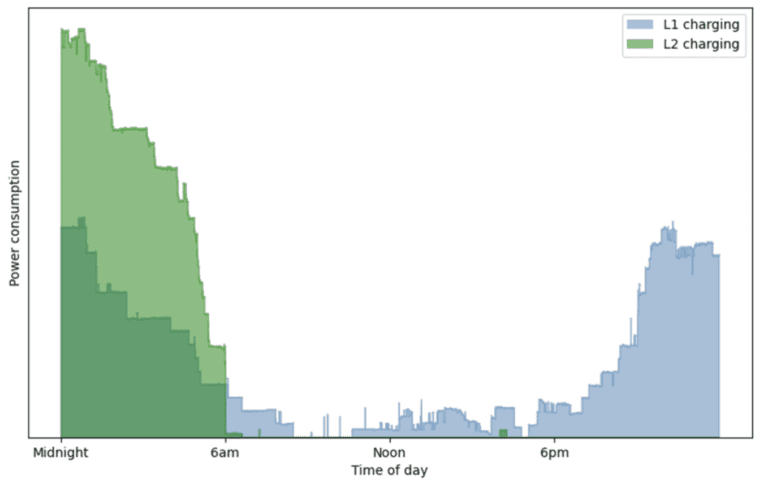
In Sense’s Australian pilot, we’ve achieved a 100% detection rate on EVs in Melbourne. The graph above illustrates the sum of consumption across the day, with L2 chargers in green and L1 chargers in blue, highlighting a clear difference in charging styles.
All EVs on L2 faster chargers turned on instantly at midnight, while manageable now, such sudden switch-ons could cause challenges for the grid, leading to spikes in energy prices. This scenario demonstrates the need for replacing a single static TOU tariff with more flexible TOU and demand response strategies.
L1 slow chargers distribute usage throughout the day. While they consume a similar total amount of power, there is an opportunity to shift this load to support capacity and reduce costs.
Positioning EVs for better reliability
Globally, utilities are exploring solutions to enhance grid resiliency and reliability of supply to customers. In the UK, trials are underway to use EV batteries for home backup power and grid support. In Japan, Nissan’s EVs provide emergency power during disasters. Similar pilots are gaining traction in countries like Australia and the Netherlands.
Pilots show significant potential for harnessing EVs for home backup power (V2H) and grid resiliency (V2G). EV batteries can hold approximately 60 kWh of energy, enough to power a home for a couple of days with conserved use.
Bi-directional charging, when mandated for EVs, ensures power stability for both EV owners and other consumers who could benefit from these “rolling batteries” when the grid becomes constrained.
For these programmes to succeed, customers must feel in control. They want to do the right thing but also need assurance that their EV will have sufficient charge for their next journey. With solutions like Sense, the whole home’s needs and resources can be calculated along with customer preferences, ensuring the right decision is made each time.
In the end, engaged consumers are ready and primed to manage their energy usage, including EV charging.
The post The EV Revolution appeared first on Sense.
]]>Read how our team created an onboarding experience that is both easy and secure for consumers connecting their new smart meter to the Sense app.
The post Connecting with Confidence: Sense’s User-focused Onboarding Journey appeared first on Sense.
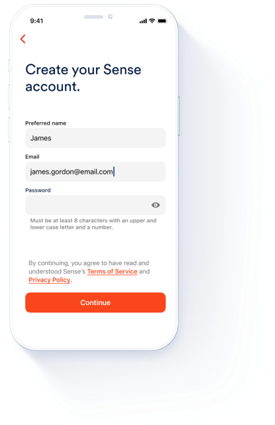
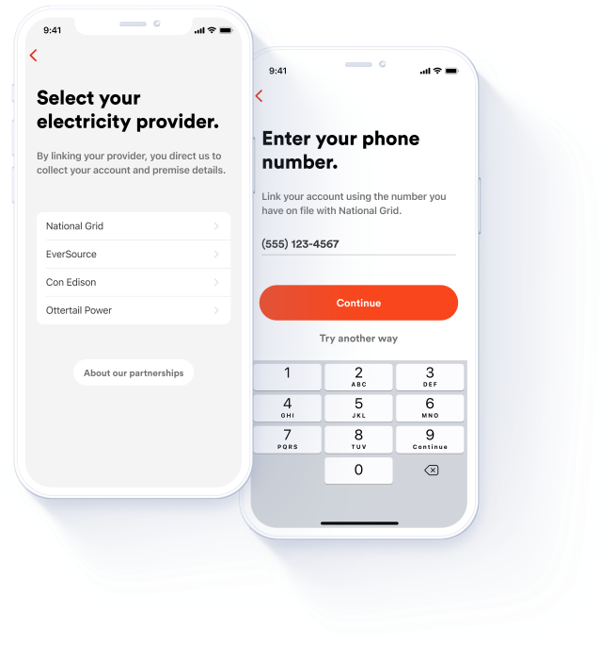
]]>Sense has put intense thought, effort and research into making the onboarding journey easy and intuitive for the user. Connecting a smart meter to the Sense Home app requires multiple steps. Because of this, the Sense team set out to design a simple onboarding experience around the three principal steps: creating your account, linking to your utility, and connecting your meter.
Creating your account
Users create a Sense account that will be used to gain access to the Sense Home app going forward. Using standard design conventions, users can quickly set-up their account credentials and also explore detailed information about our privacy policy as well as the terms and conditions of service.
Linking to your utility
We make this process easy on the customer, including the ability to verify their account through their phone number so they don’t need to have their bill handy. We also want this process to feel secure, so consumers know how much we value their privacy and safety, so we’ve adopted industry standards like two-factor authentication.
Connecting your meter
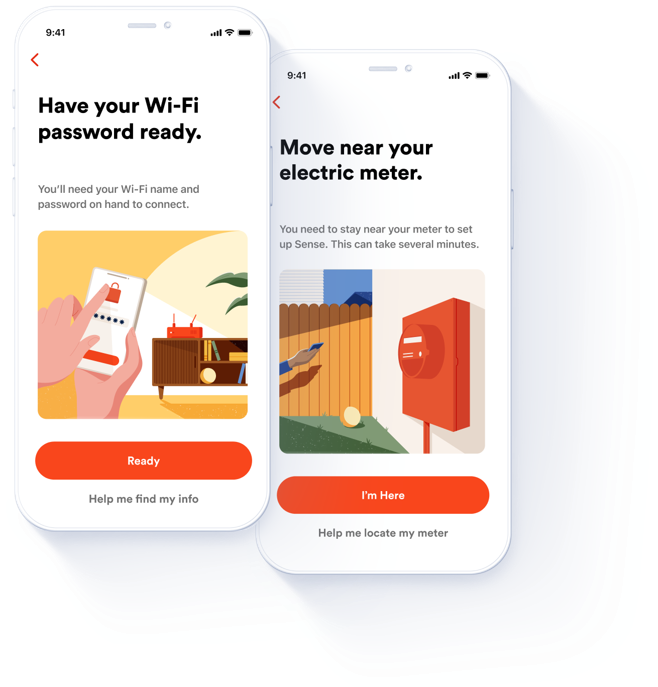
The Sense onboarding journey is also a journey in a very literal sense. In order to pair the meter to the app, the user needs to move to the meter, wherever that may be, in or outside of their home. Everyone’s configuration is going to be different. Maybe it’s in the attic, the basement, outside, etc. Wherever it is, we want to make it simple for consumers to take this step of the journey.
Sense put a lot of thought into anticipating the questions users would have and designed help articles along their journey in the app to address them. Customers must enter their Wi-Fi password to complete the step at the meter. Sense wanted to avoid people walking all the way to their meter location and perhaps not having the password on hand. After all, not everyone has their password memorized.
While the user is on that screen, they can easily access help to find and test their Wi-Fi. The help article flow was a collaboration between our support team, who deeply understand customer issues and concerns, and the product and engineering team, who understand where in the process to make this information easily accessible to customers.
Nothing like Sense has ever existed on the market, so being able to tie it into an experience where the customer already feels comfortable goes a long way in early engagement. Together, our design and engineering teams worked meticulously to craft an inviting and familiar experience for new customers. The Sense team looked at smart home and financial management apps, and of course social media apps, as examples of familiar and intuitive customer journeys.
Our comparisons to social media sites like Instagram and Facebook can only go so far, though. After all, customers aren’t sharing funny memes and photos of their dogs. They are sharing their home usage data, and for a lot of people, that’s personal.
The customer journey addresses this with transparency, explaining in plain language what, exactly, they are sharing. Sense engineers build apps that they themselves would want to use, and that includes clear information on what is happening with their data.
Sense wants customers to enjoy the journey from the time they download the app until they are seeing the actual results of their work, like saving energy and money. Sense bakes security into every step of the journey, and delivers to customers an onboarding experience that will set them up for success.
Sense is on this journey with our users, and we’ve made the road we travel on together as clear and comfortable as possible. It takes a lot of work to make it look easy, but it’s work that we know will benefit all of us as more and more consumers use less energy, with every download taking us closer to a brighter future.
The post Connecting with Confidence: Sense’s User-focused Onboarding Journey appeared first on Sense.
]]>The post Real Time, Revenues and Retailers appeared first on Sense.
]]>
By Michael Jary, Managing Director for APAC & EMEA
How embedded intelligence on smart meters can transform retailer business models, unlocking new revenues and revitalising customer relationships
Energy retailer business models have faced extraordinary pressures for over a decade. The inexorable rise in energy costs, together with regulatory intervention and increased customer churn, have eroded retail margins. Attempts at diversification to adjacent businesses such as home services have often struggled because the necessary competencies can be starkly different.
At the same time, grid edge intelligence and real-time, appliance-level load disaggregation are generating huge interest in the energy sector. Advances in technology and AI mean that this long heralded technology is a compelling proposition. Sense software runs on a wide and growing range of third party next generation smart meters. With millions of next generation smart meters due to roll out with Sense capability in North America, decision makers worldwide are now specifying these advanced meters for future rollouts.
The benefits to consumers and the energy transition are clear. Sense intelligence represents a powerful tool for reducing both their energy consumption and their carbon footprint. It also reduces the overall cost of managing, maintaining and balancing the energy system.
Importantly Sense doesn’t require any extra hardware in the home. At the marginal cost of software, it is highly scalable as it does not carry the inhibitive cost and complexity of extra hardware, installation visits, and/or wastage.
Sense is the single most cost effective energy efficiency investment available today and it has the potential to transform retailer business models.
So how does Sense intelligence work?
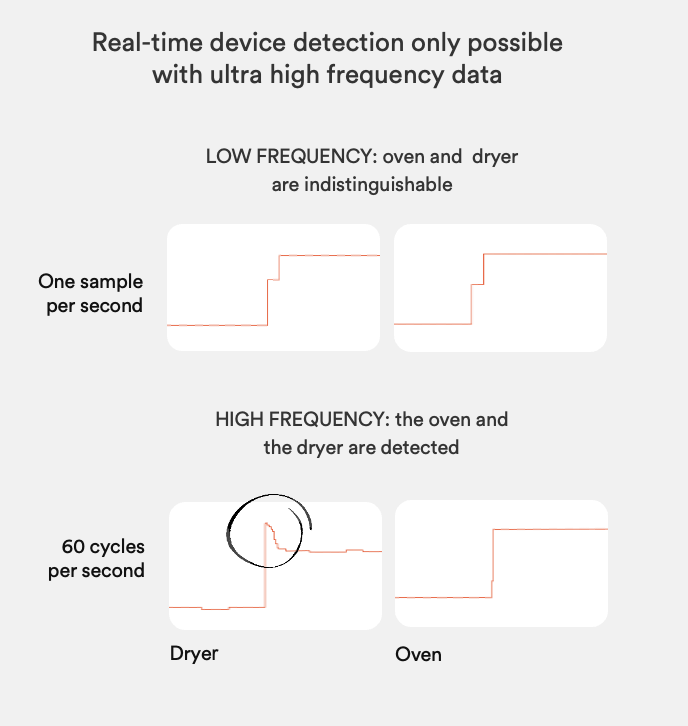
Intelligent machine learning software can run within next generation smart meters. By analysing high resolution energy data on the meter’s processor, the AI software is able to spot patterns and anomalies in the voltage and current. This pattern recognition can be used to identify the unique power signatures of different devices in the home and determine how much power they are using in real time. Device detection and two-way communications are shared with the consumer via an app. It can also be used to spot faults on the grid or in the home. This high resolution processing takes place within the meter itself, so cloud costs and latency are low. Granular insights can be issued on demand into Retailer backend systems.
Improve retention with engaged, satisfied customers
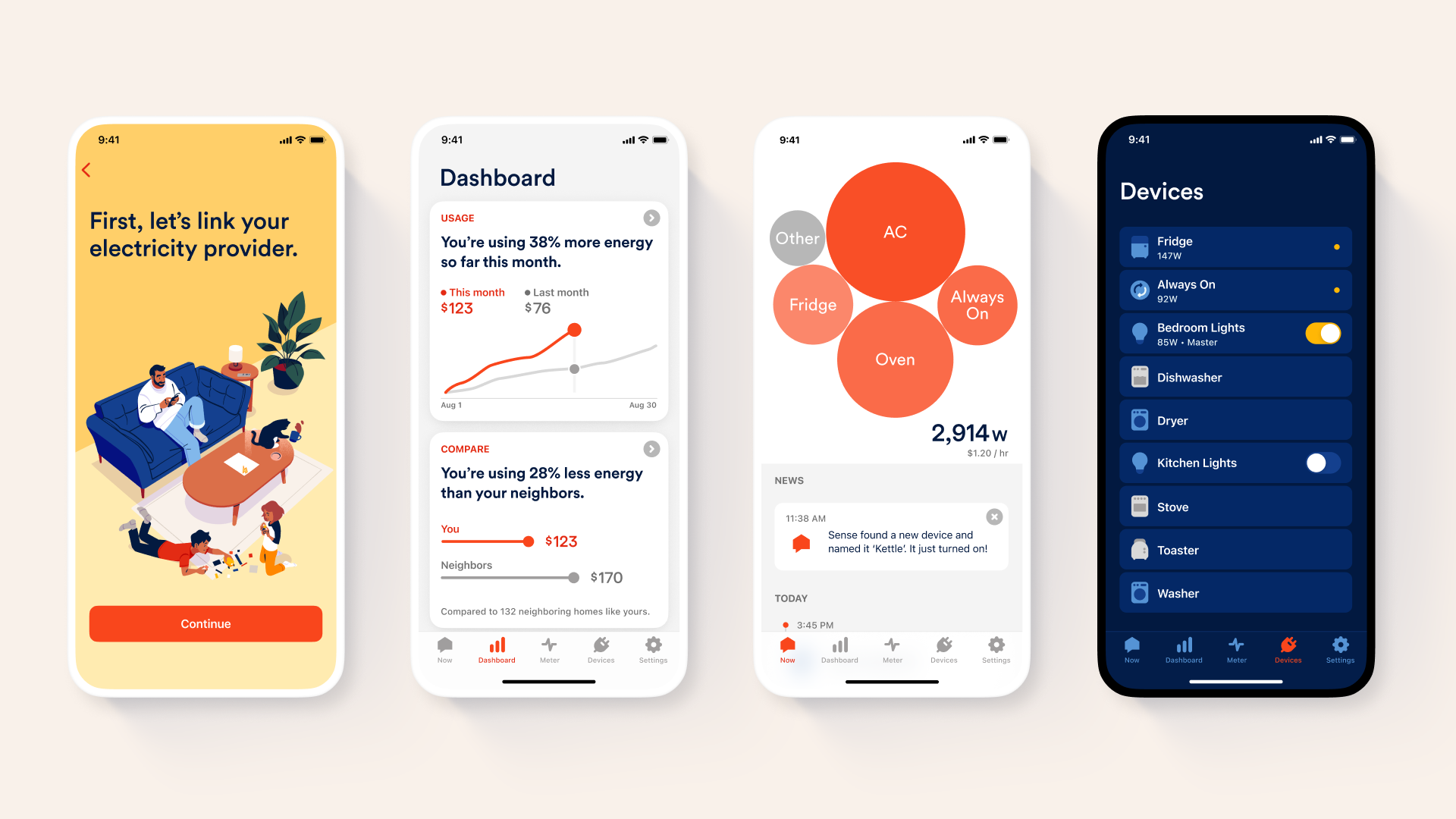
Sense’s award-winning app is a powerful way to engage customers. It does this by giving consumers a product of genuine value. Sense provides them with an innovative new tool – at no charge – that is able to identify how much consumption individual appliances are using, historically and in real time. People can see instantly whether they’ve left an energy-hungry heater on, identify an old, inefficient water boiler, or understand the behaviours contributing to their energy bills. Energy consumption is broken down to individual appliances in the home, with instant feedback when it’s turned on or off. With this insight, users find it easy to reduce their consumption. On average they save 8% on their bill.
Consumers benefit from greater home awareness, too. They can get custom notifications to make their lives simpler and safer. Did they forget to turn the iron off? Is someone at home? Is the air conditioning or clothes dryer faulty? As a result, a typical consumer opens the Sense app 2 to 3 times a week, even after a year of usage.
Retailers have the opportunity to engage more positively with their customers. Too often communication with their customers can be negative – when the bill arrives in their inbox or a complaint prompts a telephone conversation. However, with Sense, there are many opportunities for regular, welcome engagement. When a retailer steps in to help a customer, either by reminding them they’ve left the oven on or by helping them manage their bills, perceptions start to change. Consumers are surprised and delighted. The relationship can be transformed – and the result is a happier, informed and more loyal customer base.
Acquire customers with lower bills, not lower margins
Retailers that offer Sense to their customers can acquire more customers without sacrificing margin. All customers want lower energy bills. However, to compete and acquire customers, retailers have had to offer hefty discounts. These customers tend to be price sensitive with high propensity to churn when the discount period ends. Instead of relying on loss making tariffs, retailers using Sense can compete on total bill size rather than cost per KWh. Consumers with Sense reduce their consumption by an average of 8% but retailer margins remain healthy. These types of customers are less likely to churn too. To match that offer, competing retailers would need to operate on negative margins of minus 10%.
Loosening their dependence on switching sites, retailers working with Sense can establish a clear competitive advantage over the discounters. Consumers can reduce costs and crucially, their carbon footprint too.
Reduce power costs with domestic demand response at scale
Managing the grid is going to become extraordinarily challenging in the coming years. The electrification of heat and transport will trigger a surge in load. A grid dependent on renewables will be unable to dispatch sufficient supply to balance it. The spikes in demand will exacerbate peak pricing. Energy retailers that are able to limit consumption during those times will reduce their costs and grow their margins. However, most domestic flexibility solutions in the market today are prohibitively expensive and difficult to scale. They require the installation of connected batteries or other appliances. Time of use tariffs have poor uptake and customers struggle to cut enough consumption at the right times. However, with an engaged and informed cohort of customers, flexibility can be secured at much greater scale and lower cost.
Sense enables a different type of domestic demand side response that doesn’t rely on expensive in-home installations or unpopular time of use tariffs. Using real-time device detection, Sense can detect the highest consuming appliances on the grid at any time, and issue messages to consumers requesting they turn down specific devices. If the device is IOT enabled, they can be controlled directly. The same technology makes time of use tariffs much more effective. Immediately before a change in pricing, consumers can be sent a personalised message with a reminder and provided with suggestions on the precise appliances they should consider turning down. The flexibility and immediacy means even variable time of use tariffs become viable.
One clarification: the load disaggregation must be accurate, real time and appliance level. Other load disaggregation technologies using lower resolution data have been shown to be too unreliable, late and clumsy to be effective. However, if the disaggregation is real time, householders are then able to turn off the most impactful appliances that are using power at that moment. They don’t waste time and effort on minor appliances, such as laptops or low energy light bulbs. Customers retain agency and choice, so the risk of alienating consumers is removed. By doing the hard work for them, retailers can increase satisfaction, participation rates and flexible load substantially. When homes without Sense are asked to shift load, an average of just 2-4% of peak consumption is typical. In homes equipped with Sense, this soars to 18%.
Crucially, this form of domestic flexibility requires only Sense software on next generation meters. The software can be affordably rolled out, downloaded on a new meter, and distributed to an entire customer base with minimal marginal cost. Once at a reasonable scale, load under control becomes predictable and reliable. For a medium sized country such as Australia, Sense on smart meters would be the equivalent of adding 2.4GW to peak capacity. That’s as much as two nuclear power stations!
Improve insight and forecasting with better data
With appliance level data, energy retailers can derive significant benefits. The most direct advantage is enhanced forecasting. By supplementing demand forecasting models with appliance level insight, future load can be more accurately predicted. By combining appliance level data for heat, cool, and transport with existing weather and historic billing data, forecasts can be fine-tuned. This allows for more accurate power purchasing, and optimised hedges, ultimately leading to lower power costs.
The same appliance level insight can be used to better understand customers and their needs. Service and support can be enhanced with richer customer segmentation and insights.
Creation of new revenue streams, clear competitive advantage and the requisite capabilities to excel
As part of this proposition, consumers are asked to share their data with authorised market participants, including the retailer. Their permission is sought in a GDPR-compliant, clear and transparent manner with the broader benefits of doing so laid out. Personally identifiable information (PII) is held separately from their energy data, with the highest security standards applied. Consumer data is not shared with any third parties without the express permission of the customer, and only in circumstances which are to the benefit of them and the energy transition.
However, once approval is acquired, new business models can be created. If the customer consents to share their appliance data, energy retailers can offer new proactive services. They can identify older, energy inefficient appliances and sell more environmentally friendly replacements, helping customers save money on their bills. By identifying and pre-empting risk in the home, insurance can be made more price competitive.
Energy retailers have always been in the data business. That data may have been analogue rather than digital, collected by an army of meter readers, processed, and then billed back to consumers. Their advantages lay in data collection and processing, anchored to a unique metered asset in the home, and the infrastructure and relationships to communicate with millions of consumers. These new business lines leverage those core capabilities. Unlike many diversified lines of business, energy retailers have genuine competitive advantages in these new services, and are therefore much more likely to generate material and sustained margins.
Retailers can share in the revenue opportunity unlocked by grid edge intelligence
It’s not just retailers and consumers that can benefit from load disaggregation and grid edge intelligence. Other authorised energy market participants, consented to by the customer, can also generate substantial operational savings and broader benefits. For instance, distribution networks and demand aggregators can source flexibility as well as measure and verify load shifts. Sense technology can identify and locate faults on the low and high voltage grid and also provide high-resolution power quality, total harmonic distortion, frequency and voltage insight from the grid edge. This unique data can help optimise grid management, improve reliability and create savings for grid operators.
To support the advancement of electrification, knowing where EV’s are charging is vital information for them. Increasingly grid operators will also need demand response services to ease network congestion and ensure grid stability. With the growing deployment of EV’s and heat pumps, these tools will help maintain a good power supply and reliable service to customers.
These services all have substantial value to those other parties. That’s why, when a retailer specifies a Sense-enabled meter, they can share in these incremental revenues on an ongoing basis, even if the original customer churns away.
Concluding thoughts: building a business model for a digital, low carbon grid
Energy retailers play a vital role in both the global economy and in the energy transition. However, their business models have experienced substantial pressure for several years. But with Sense, energy retailers can build a new, sustainable business model fit for a low carbon, digital grid. By improving customer satisfaction, churn falls. By enhancing forecasting and shaving wholesale price peaks, power costs fall. Influencing demand will be as valuable as providing supply. Instead of giving away margin by competing with discounters on pence per KWh, customers can be offered lower consumption, carbon and bills. New services can be provided, founded on a rich digital relationship with end consumers, that can outlive the original supply agreement. With Sense, retailer margins and revenues can expand based on a clear and enduring competitive advantage.
Sense provides software for next generation smart meters, and we work with smart meter manufacturers, energy retailers, and grid operators. So if you’re considering your next generation business model and are readying for your first or second wave of smart meters, please reach out to discuss how we can help.
A note on the author: Michael Jary is Managing Director for APAC & EMEA at Sense. Earlier in his career, Michael was Head of Retail Strategy at SSE and British Gas, two of the largest energy retailers in the UK.
The post Real Time, Revenues and Retailers appeared first on Sense.
]]>The post 15 Seconds to Being More Energy Efficient appeared first on Sense.
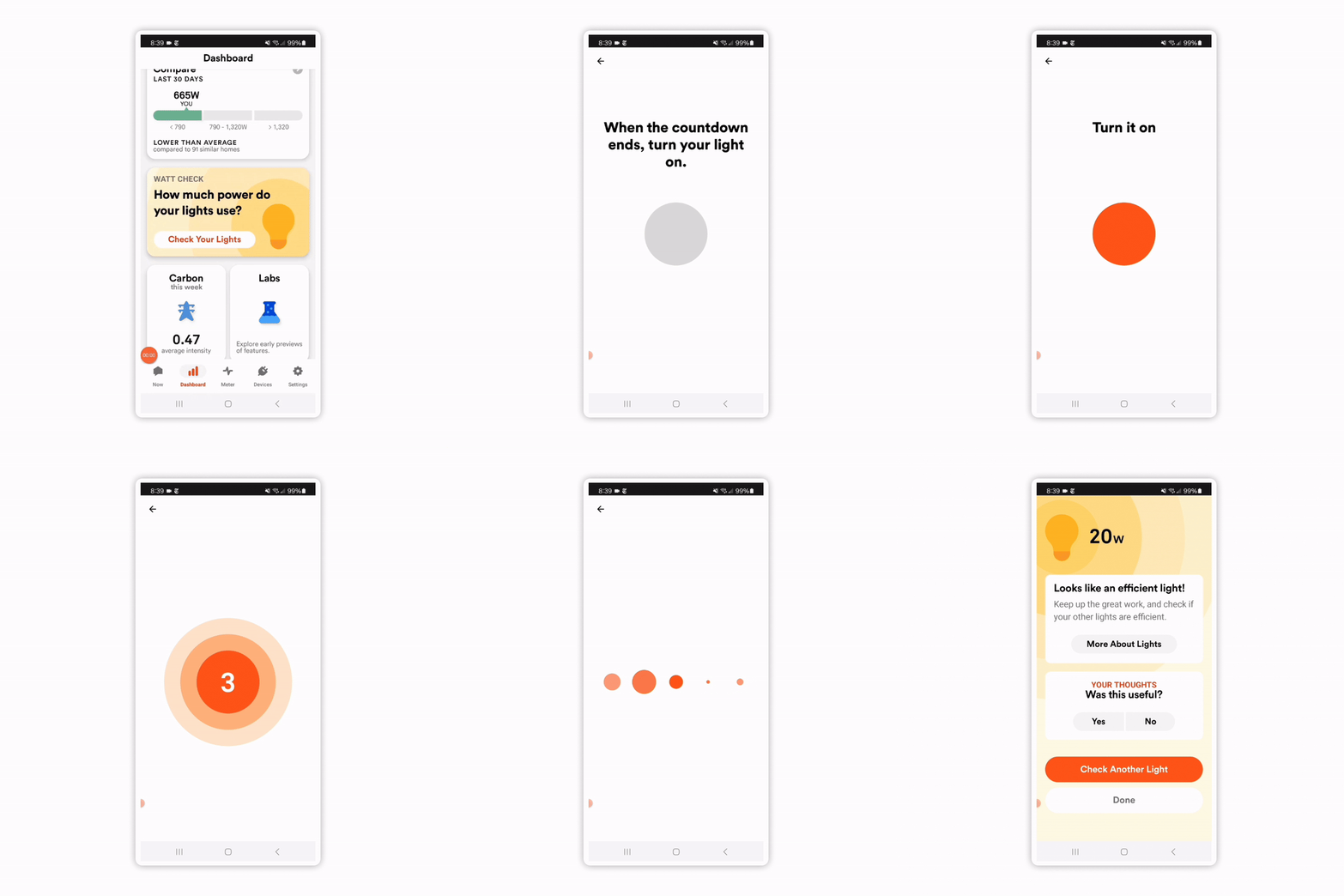
]]>15 seconds can change the way people think about and engage with their energy usage. That’s the amount of time it takes Watt Check, Sense’s new feature that tests the wattage of current light bulbs, to test and report back to consumers how energy efficient their bulbs are, and make recommendations for improvements. And soon, Watt Check could expand to even more devices.
The recent Smart Energy Consumers Collaborative’s Customer Satisfaction and the Smart Grid report reinforced that consumers want to know more and engage more with their energy usage, and when given the right tools, they make changes that allow them to save money and use less energy.
So, if energy consumers have 15 seconds to spare, Watt Check can help.
Consumer Engagement is at the Heart of Watt Check
Sense’s philosophy is to create an experience that is collaborative and fun for our users. We see users opening the Sense app on average 1-2 times per week. So much information about electricity use is technical and difficult to understand, even for people who really know how to read their bill.
Even if you are a pro-level bill reader, you might not know what you can do to lower your consumption and your costs. Sense bridges the gap between the information that users are already getting from their utility and provides information they can use day-to-day to make changes in their life and see the outcomes.
Watt Check was developed to help users understand within 15 seconds what they can do right now to make meaningful changes in their energy consumption. Users can jump right in and start learning. The Watt Check experience was designed to be fun and even a little magical. When you get that first result and the light bulb lights up in animation, it can feel a little, well, delightful.
Very simply, you see how many watts you are using and how much is it costing you.
Everyone Can Have a Lightbulb Moment
When you ask people what they think about the most in terms of energy usage, it’s overwhelmingly lights. People perceive that it’s important, and that is critical when we’re trying to figure out ways to engage people on their energy usage at home. This probably stems from most energy users having the universally shared experience of being told over and over again to turn off the lights when you leave a room.
While those of us in the energy industry know that lights are a relatively small contributor to home energy use, for many people it’s an important entry point to engaging with their energy use. Lights can also be really impactful, because it’s something that people really understand, and the results can be seen immediately. If you don’t have efficient bulbs in your home, replacing them can be a savings driver. It’s not the biggest thing in most houses, but it is something that almost everyone has in their home.
Lighting is also something that resonates with almost all consumers. There are many types of customers that simply get left behind with cookie-cutter energy efficiency programs. For example, not every energy consumer can replace their HVAC system with a heat-pump. Watt Check provides a level playing field.
When the Switch Flips
Watt Check has a feedback and rating module built into it, and overwhelmingly users are rating the experience as useful. In the first month, over 1,200 Sense users have said the results they were seeing from Watt Check were useful.
“I talked to one Watt Check user who was excited to try the new feature because he ad different bulbs in different fixtures in his house, a mix of CFL and LED, knowing CFL bulbs aren’t as efficient as LED,” said Becca Smith, Product Manager at Sense. “He was shocked to see just how less efficient CFL bulbs were in comparison, to the point that he went out that very day and purchased LED bulbs for all of his fixtures.”
Watt’s Next?
Watt Check is all about the lightbulbs now, but Sense plans to update and expand Watt Check, and use the same principles to help consumers understand other devices and appliances in the home, such as fans, space heaters, toasters, blow dryers, and more.
While these might seem like small devices, many of them, like a space heater, can use an eye-popping amount of energy. Some of you might even have one on right now as you read this at your desk. You might want to unplug that and grab an extra blanket instead.
Watt Check, while simple to use, is the product of many complicated pieces of information coming together in an easy-to-use interface. These simple concepts are sometimes the hardest to explain, but when approached with Sense’s commitment to superior customer experience and engagement, Watt Check provides consumers with exactly what they want and need: a tool to tell them today what they can do to save energy and money tomorrow, and beyond.
The post 15 Seconds to Being More Energy Efficient appeared first on Sense.
]]>